

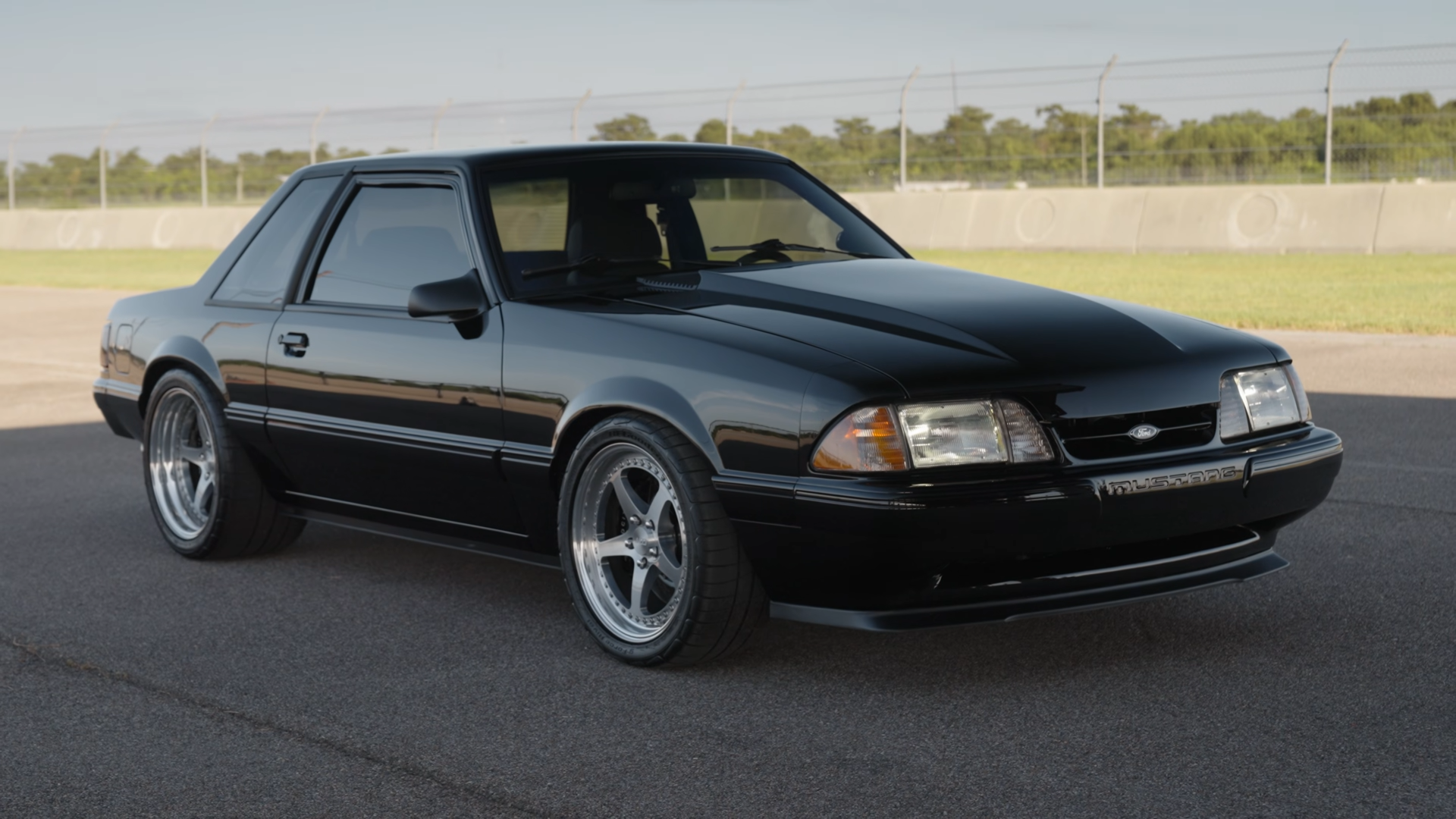
The third-generation Ford Mustang, better known as the Fox Body, has long occupied an unusual place in American performance-car history. Lightweight, affordable and easy to modify, the 1979–1993 Mustang became a staple of the street and drag-racing scenes. Yet its reputation was never built around sophisticated chassis dynamics or refinement. Velocity Restorations’ interpretation takes a fundamentally different approach: preserve the unmistakable character of the Fox Body while replacing much of its mechanical architecture with modern performance hardware.
The result is a Mustang that looks remarkably close to a highly preserved late-1980s or early-1990s example at first glance. Velocity deliberately avoids the exaggerated styling often associated with high-end restomods. The familiar body panels, headlights, bumper details and expansive glasshouse remain intact, while the panels are substantially cleaner and straighter than those of a typical original car. The exterior modifications are deliberately restrained, with a two-inch cowl hood and 18-inch billet three-piece wheels providing some of the most obvious visual clues.
Modern tires, including exceptionally wide 335-section rubber at the rear, give the Mustang a much more serious footprint. The car can also be commissioned as either an LX notchback or GT hatchback, with BASF paint available in virtually any desired color. At the rear, period-style exhaust tips and the absence of a prominent spoiler maintain the understated aesthetic. It is only when the car is viewed in profile that the substantially altered stance becomes obvious.
A Second Chassis Changes the Fox Body Formula
The most significant engineering work is hidden underneath the familiar bodywork. Rather than attempting to reinforce the original unibody with conventional subframe connectors, Velocity mounts a Roadster Shop-spec chassis beneath it. In effect, the Mustang retains its original body structure while gaining a substantially more rigid foundation.
That additional structure is critical because the original Fox Body’s lightweight unibody was never designed around the levels of power that later generations of enthusiasts routinely extracted from Ford’s V8 engines. Chassis flex could compromise suspension consistency, while the factory live rear axle and relatively basic suspension architecture limited the car’s ability to exploit additional horsepower effectively.
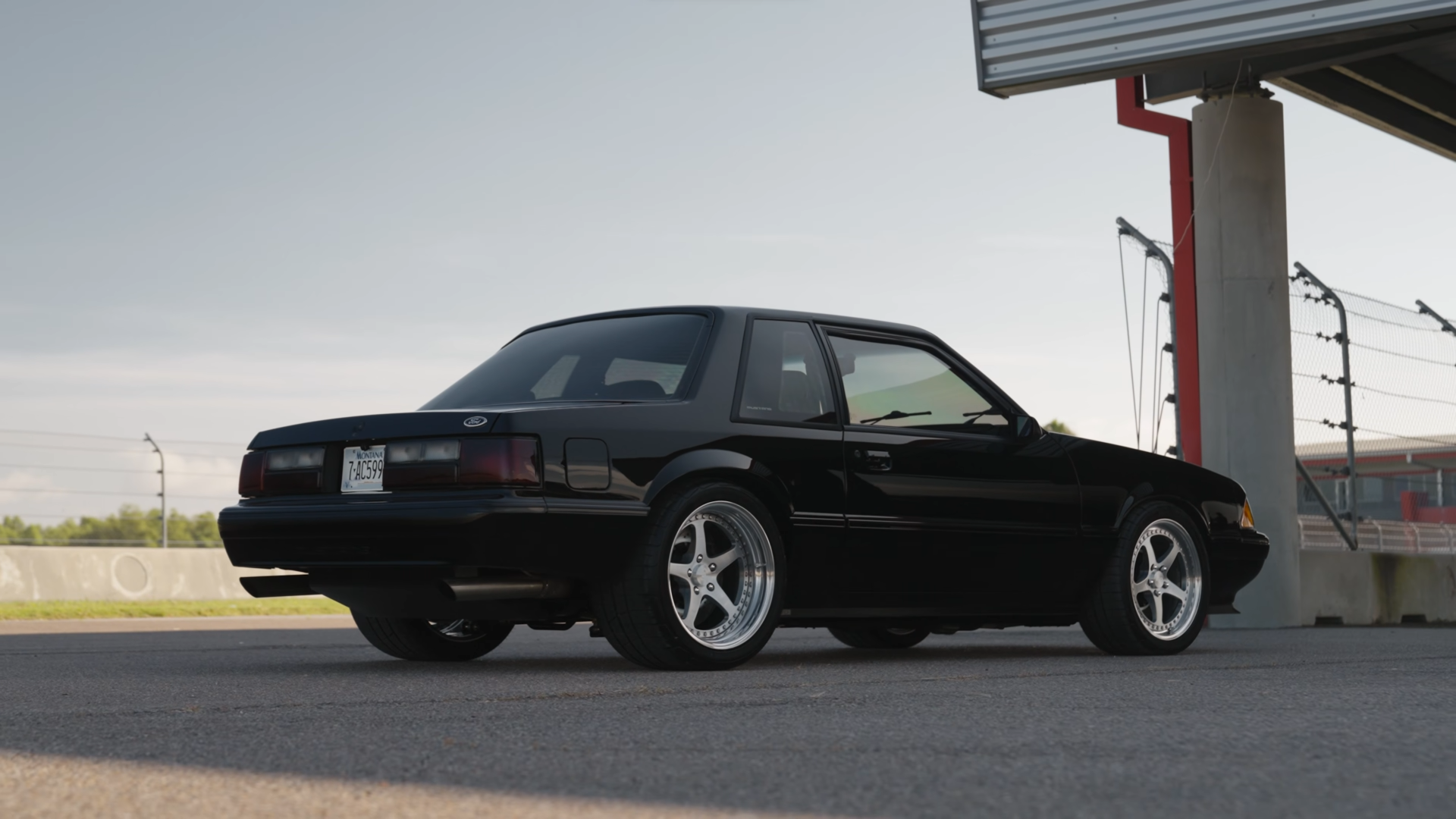
The Roadster Shop chassis addresses those shortcomings with independent front suspension, a multi-link rear arrangement and coilovers at both ends. A Ford 9-inch rear axle, 3.55:1 gearing and carbon-fiber driveshaft complete the drivetrain architecture. Braking hardware is upgraded with disc brakes and six-piston calipers at all four corners.
The philosophy is not simply to make the Mustang faster. It is to give the chassis enough structural integrity and suspension control to make the additional performance usable.
Coyote V8 Power With Modern Transmission Technology
At the center of the transformation is Ford’s 5.0-liter Coyote V8. In naturally aspirated form, the engine produces approximately 500 hp, already representing a substantial increase in capability over the engines traditionally associated with the Fox Body.
Velocity offers an optional Whipple supercharger that raises output to 715 hp. With the Mustang weighing approximately 3,000 pounds before certain performance additions, that figure gives the car a formidable power-to-weight ratio.
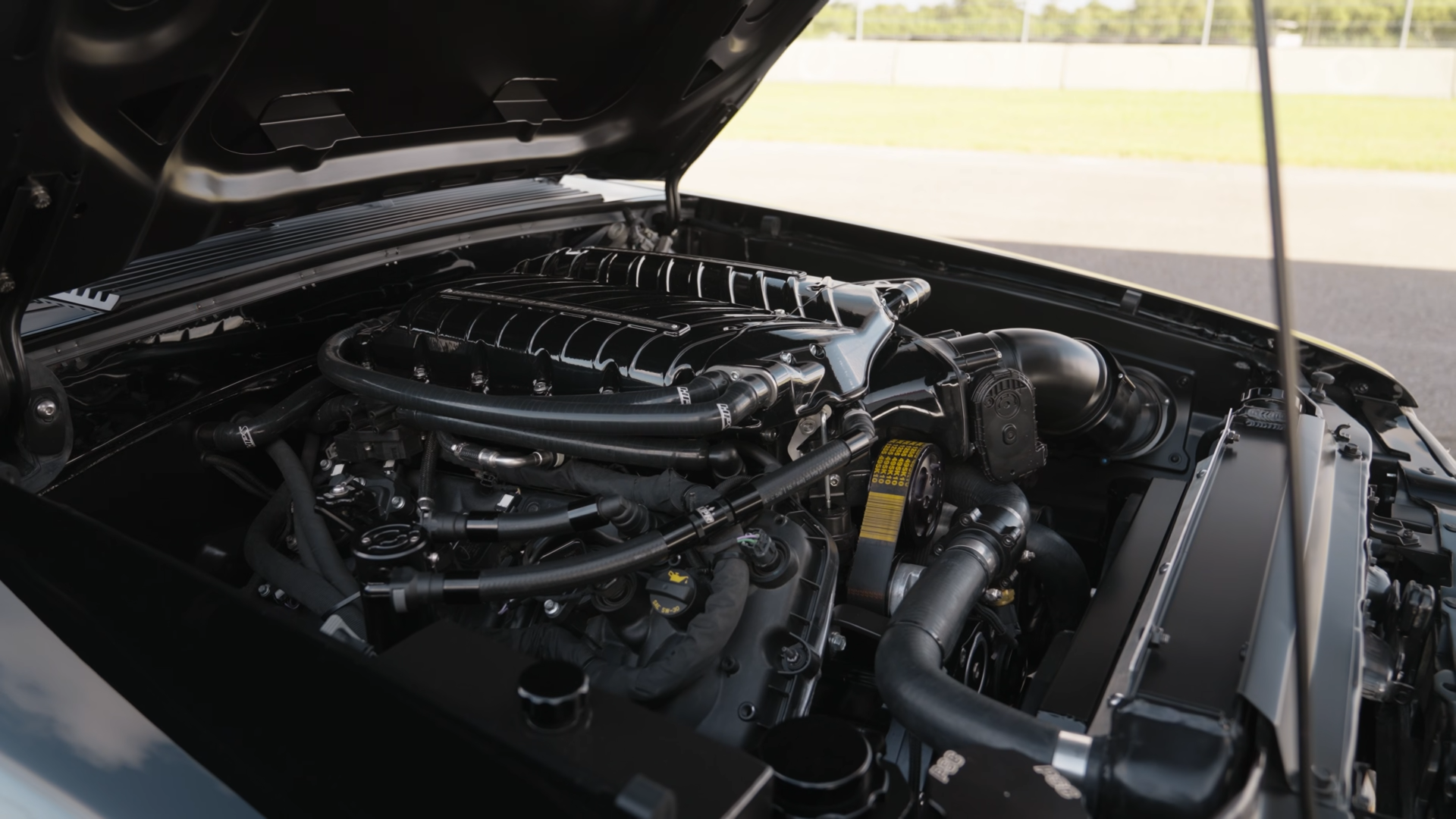
The engine drives the rear wheels through a 10-speed automatic transmission. Integrating that powertrain into a chassis originally designed around considerably smaller and older drivetrain technology required extensive fabrication. The engine bay had to be reworked, including modifications to the inner fenders, while the transmission tunnel required additional clearance for the physically larger 10-speed gearbox.
This is where the distinction between a conventional restoration and a genuine re-engineering program becomes apparent. Velocity is not simply installing modern components into an old engine bay. The surrounding structure must be adapted so that the new mechanical package can operate reliably while remaining visually compatible with the original car.
An Interior Designed to Look Familiar
Inside, Velocity applies the same philosophy with even greater subtlety. The objective is not to turn the Fox Body into a contemporary luxury car but to make the original interior feel as though Ford had produced a dramatically better version of it.
The basic dashboard architecture remains recognizable, including the characteristic shape and T-style shifter. Yet almost every tactile component has been reconsidered. Door panels use period-inspired 1980s and 1990s fabrics combined with Alcantara, precise stitching and significantly improved materials.

Heated Recaro bucket seats provide modern support without abandoning the period aesthetic. The steering wheel retains the visual language of the original while being redesigned as a smaller billet component, incorporating the factory-style cruise-control and horn controls. Dakota Digital instrumentation reproduces the appearance of conventional gauges while adding modern functionality, including boost and air-fuel monitoring.
Even the ventilation system follows the same principle. Vintage Air provides modern air conditioning concealed behind an intentionally old-school presentation, while a modern audio system is styled to resemble a period cassette deck.
Electric windows, phone charging and cupholders add contemporary convenience without introducing large displays or intrusive technology. The result deliberately avoids the increasingly common restomod formula in which a classic body surrounds an entirely modern, screen-heavy cabin.
Engineering Nostalgia Rather Than Replacing It
Velocity’s approach becomes particularly interesting when viewed through its manufacturing process. The company describes itself not simply as a custom-car builder, but as a business focused on re-engineering classic vehicles. Its portfolio includes Broncos, F-Series trucks, Chevrolet trucks, International Scouts and Mustangs.
At its Pensacola facility, the process begins with donor vehicles. A dedicated team sources suitable examples based on their history and lineage rather than requiring pristine bodies, because the company has established processes for restoring and rebuilding the vehicles.
The facility operates more like a low-volume automotive production plant than a traditional custom shop. Chassis are powder-coated in-house before vehicles enter defined production stations covering body preparation, metalwork, fabrication, roll-cage installation and other operations. Rather than relying heavily on robotics, Velocity combines manual craftsmanship with a standardized production schedule.
That distinction is fundamental. The company does not build every vehicle as a completely bespoke one-off. Customers select from defined options for paint, interior materials, seats and accessories. Powertrains and transmissions are largely standardized because Velocity has already established configurations that work reliably.
This controlled degree of customization allows the company to maintain repeatability without eliminating individual choice. A vehicle can still be highly personalized while remaining close enough to an established specification that production, servicing and quality control are manageable.
Quality Control Is Part of the Engineering
The production process continues well beyond the point where a vehicle starts and moves under its own power. Velocity subjects completed vehicles to additional quality-control, testing and driving procedures.
Its test-and-tune operation includes multiple driving routes designed to expose vehicles to different speeds, rev ranges and conditions. Test drivers specifically look for unwanted rattles, squeaks and other issues that can be difficult to identify in a stationary inspection.
The company’s quality-control stage then checks tolerances and workmanship before vehicles proceed to final refit. Customers can make certain additional changes at this point, such as adding a backup camera or altering a seat configuration, without disrupting the main production sequence.
This production philosophy represents a middle ground between mass manufacturing and traditional bespoke coachbuilding: the craftsmanship remains highly manual, but the workflow is structured around repeatability.
A Restomod That Preserves the Fox Body Experience
On the road and track, the engineering changes fundamentally alter the Mustang’s behavior without completely erasing its personality. The 715-hp version combines serious straight-line performance with a chassis capable of generating considerably more confidence in corners than the original platform.
The independent suspension and modern tires provide substantially greater mechanical grip, while the additional chassis structure gives the suspension a more consistent platform from which to work. Strong brakes and the relatively low vehicle weight further reinforce the car’s performance credentials.
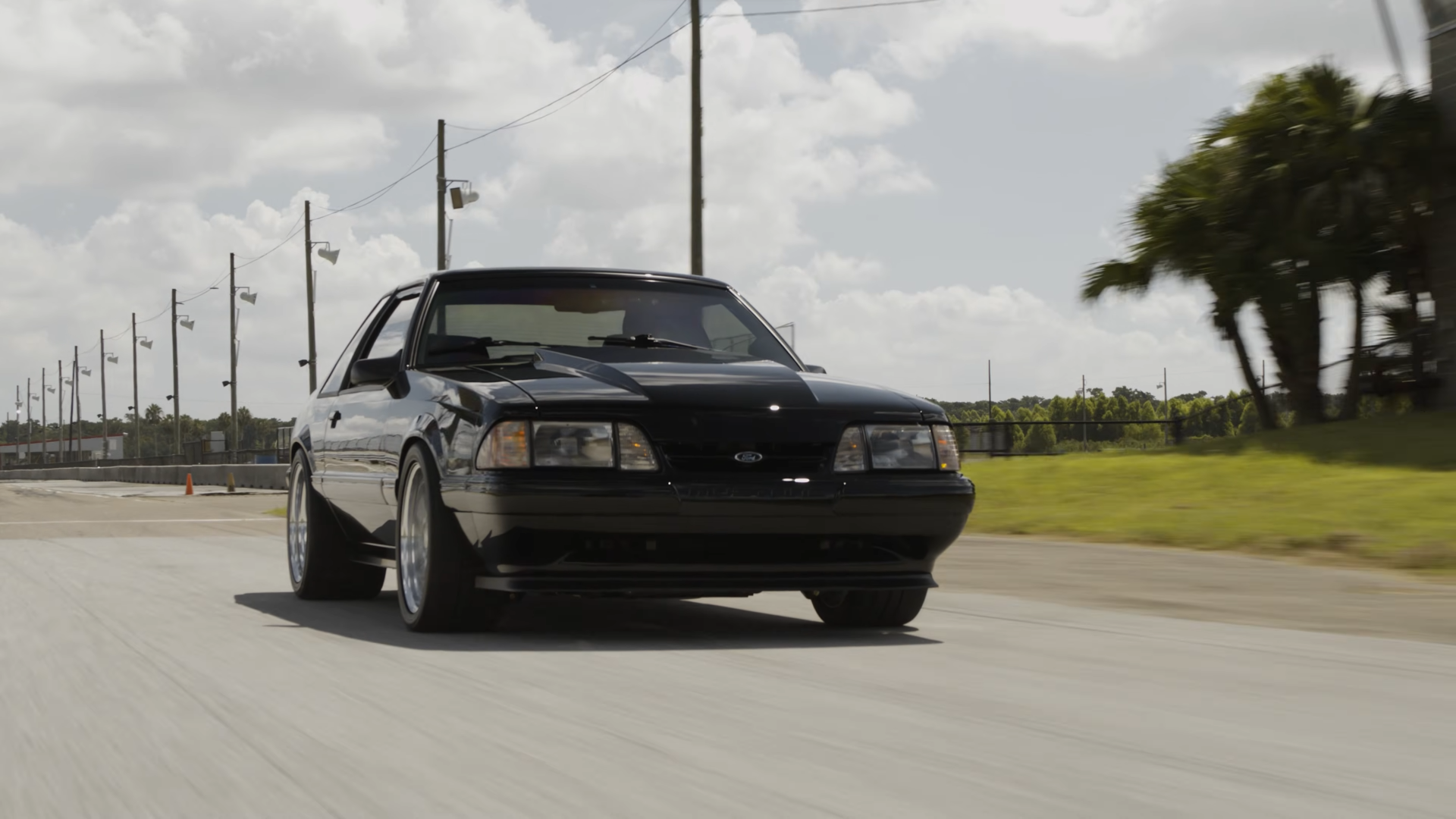
Yet the driving experience is deliberately not sanitized. The Mustang retains some of the movement and communication expected from an older performance car. It does not isolate the driver behind layers of electronic intervention, and its behavior still requires some mechanical sympathy.
The development car’s 10-speed automatic was also not entirely optimized for enthusiastic driving, with the transmission occasionally changing gears when the driver would prefer to hold a ratio. Velocity planned manual gear selection and additional drive modes for subsequent versions, illustrating that the Fox Body program remains an evolving engineering exercise rather than a finished exercise in nostalgia.
That development aspect is important. The objective is not to transform the Mustang into a modern sports car at all costs. The car is intended to retain some of the imperfections that make an older Mustang engaging while eliminating the shortcomings that make the original difficult to drive quickly.
The Best of Old and New
At a reported price in the region of $280,000 to $300,000, the Velocity Fox Body occupies a very different segment from the inexpensive Mustangs that originally established the platform’s reputation. Yet its value proposition is not based solely on horsepower or rarity.
Velocity has effectively treated the Fox Body as an engineering platform rather than merely an artifact to be restored. The original silhouette, interior character and nostalgic details remain, while the underlying structure, suspension, drivetrain, braking system, climate control and key cabin components are brought into the modern era.
That balance is what makes the project compelling. The Mustang does not attempt to disguise its age, nor does it reproduce the past so faithfully that the original car’s weaknesses remain intact. Instead, Velocity preserves the elements enthusiasts remember while systematically addressing the mechanical limitations they may have forgotten.
The result is a distinctly American interpretation of the restomod concept: recognizable, powerful and deliberately analog in character, but engineered to deliver the reliability, precision and usability expected from a modern performance vehicle.
For Velocity Restorations, the Fox Body demonstrates that successful restomodding is not necessarily about replacing everything that made an old car interesting. The more difficult task is identifying which characteristics define its identity—and then engineering everything around them to work substantially better.
Source: Top Gear