
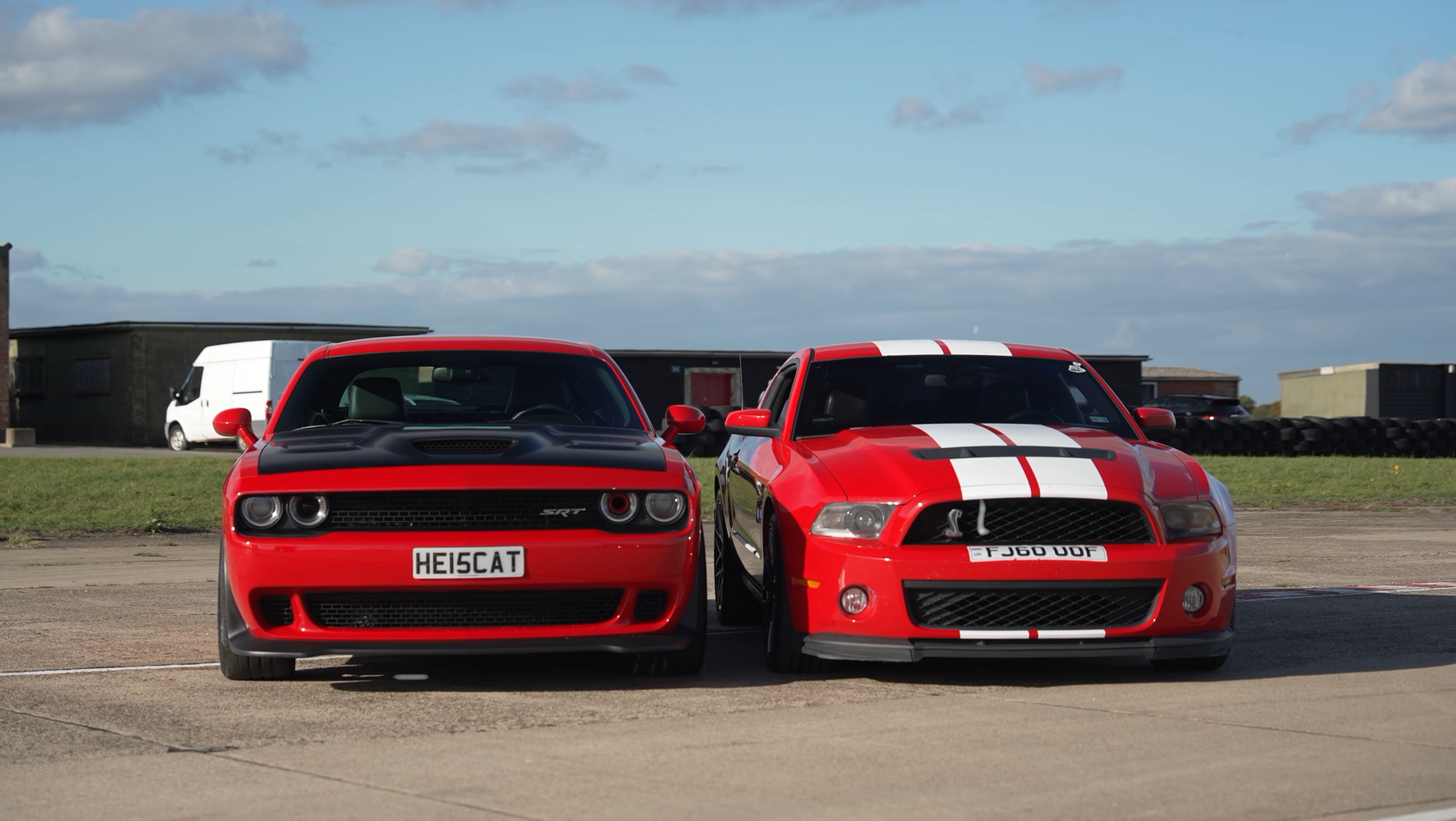
American muscle cars have traditionally been celebrated for their enormous V8 engines, straight-line acceleration, and unmistakable road presence. However, putting that horsepower to work on a technical circuit is an entirely different challenge. In a recent episode of Driven+ on YouTube, a supercharged Dodge Challenger SRT Hellcat went head-to-head with a modified Ford Mustang Shelby GT500 to determine which iconic muscle car could deliver the better track performance.
Although both cars produce approximately 700 horsepower, their engineering approaches and driving characteristics proved remarkably different. The Challenger ultimately claimed victory, demonstrating that power alone does not determine how effectively a muscle car handles a demanding circuit.
Two Supercharged V8s, Two Different Approaches
The Dodge Challenger SRT Hellcat brought considerable firepower to the comparison. Its 6.2-liter supercharged HEMI V8 produces 707 horsepower and approximately 880 Nm (649 lb-ft) of torque. Power reaches the rear wheels through an eight-speed automatic transmission, while the car’s substantial 2,045-kilogram (4,508-pound) curb weight makes it the heavier contender.
The Challenger was equipped with Continental SportContact 7 tires, providing the contact patch needed to manage its considerable power.
Opposite it was a modified Ford Mustang Shelby GT500, featuring a tuned 5.4-liter supercharged V8 producing approximately 700 horsepower and 880 Nm of torque. The engine has received modifications, including aftermarket exhaust manifolds, to increase output beyond its original specification. Unlike the automatic Challenger, the Mustang uses a six-speed manual transmission.
Weighing approximately 1,735 kilograms (3,825 pounds), the Shelby is around 310 kilograms (683 pounds) lighter than its Dodge rival. It also runs Goodyear Eagle Asymmetric 6 tires.
On paper, the Mustang’s considerable weight advantage and manual transmission suggest a potentially more agile package. However, the condition and setup of its suspension and differential would become important factors during the track evaluation.
The Challenger Hellcat: Brutal Power and Surprisingly Capable Handling
The Hellcat immediately established its personality. Its supercharger whine dominated the airfield, while the enormous V8 delivered the kind of acceleration and exhaust drama expected from one of America’s most recognizable performance cars.
The driving experience was described as brutal, particularly with the electronic stability and traction systems switched off. Its rear tires struggled to contain the engine’s output, producing considerable wheelspin and tire smoke through corners.
Nevertheless, the Challenger demonstrated more composure than its size and weight might suggest. Despite weighing more than two tonnes, it completed the technical circuit in 53.51 seconds.
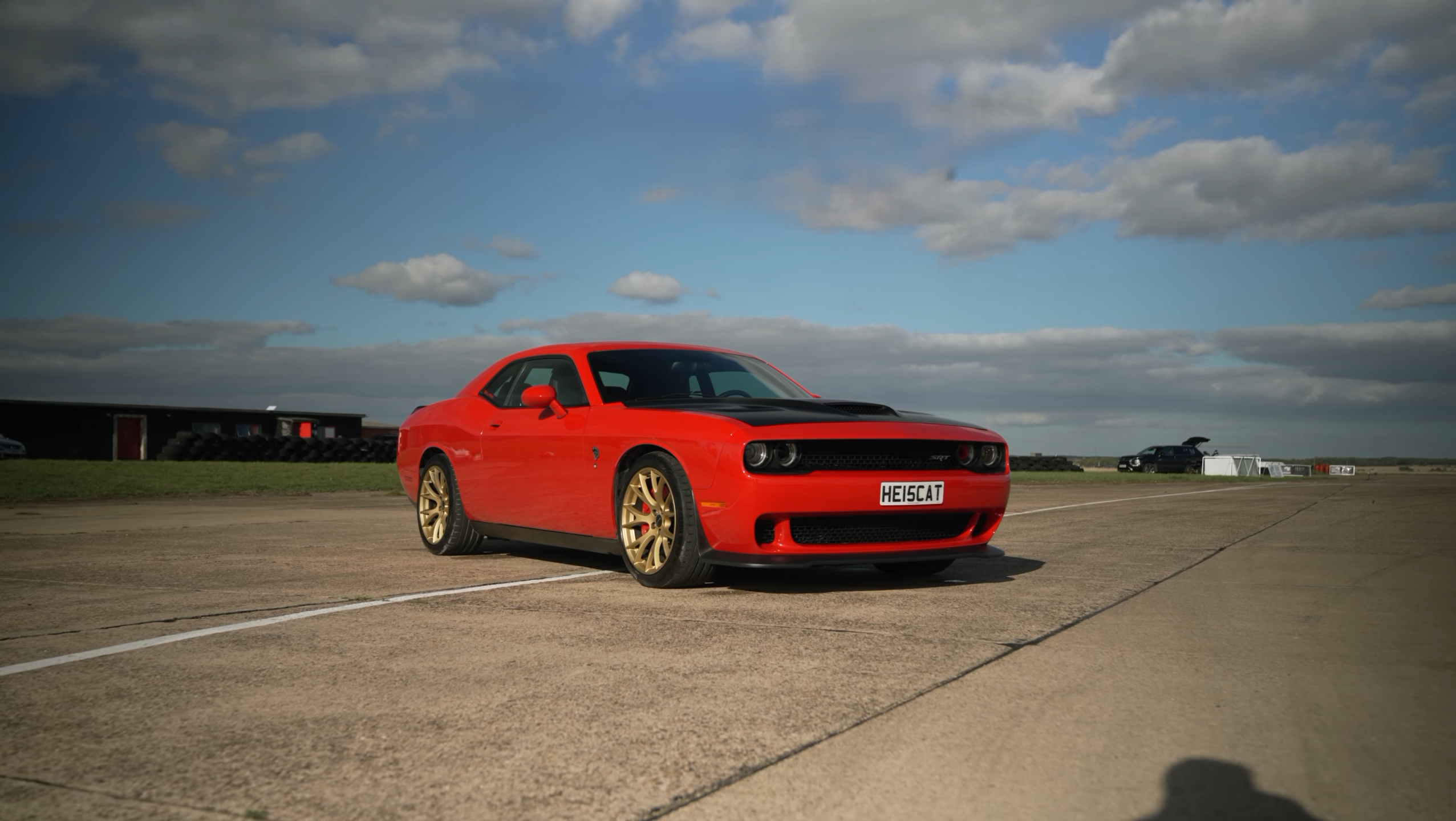
The reviewers particularly appreciated the engine, awarding it a perfect 10. The eight-speed automatic transmission received 7.5 points, while the brakes earned six. Its road-handling score was 6.5, reflecting some steering limitations and the difficulty of managing its considerable mass.
However, the Hellcat’s entertainment value was practically unmatched. Its enormous supercharged V8, dramatic acceleration, and unpredictable rear-wheel-drive behavior made it an unforgettable experience. One reviewer even described it as a new favorite car.
The Challenger’s biggest strength was its ability to combine outrageous performance with a relatively manageable driving experience, even when pushed hard.
Shelby GT500: More Power Than Its Setup Could Handle
The Mustang Shelby GT500 sounded equally spectacular, producing an aggressive supercharged V8 soundtrack that impressed the reviewers. Its manual transmission also offered a more involved driving experience, with the six-speed gearbox receiving praise for its precision and mechanical feel. However, the Mustang’s track performance quickly exposed some significant weaknesses.
Despite being approximately 310 kilograms lighter than the Challenger, the Shelby struggled to transfer its power effectively to the pavement. The reviewers identified serious traction problems, particularly through slower corners, where the rear wheels struggled to maintain grip.
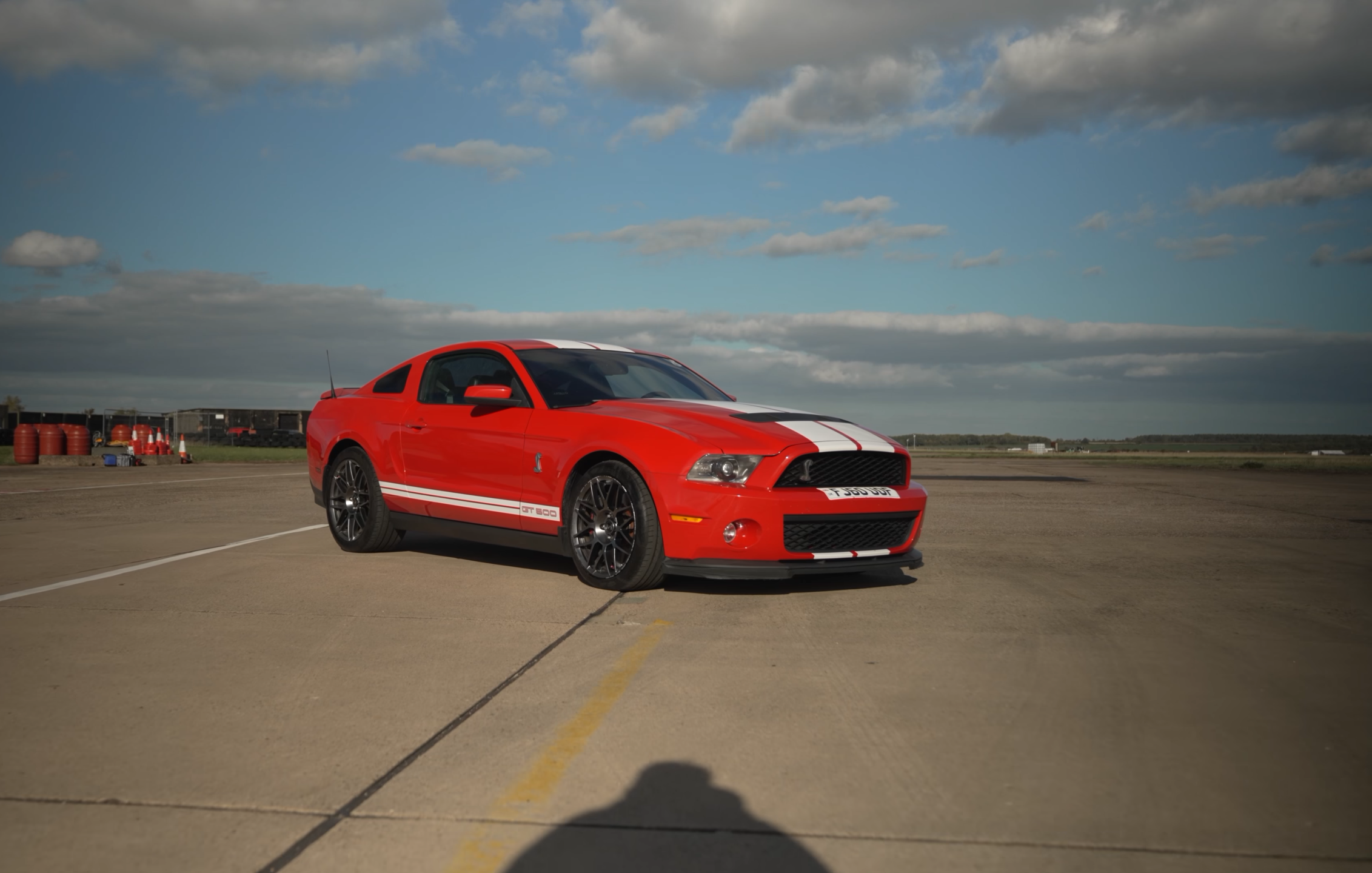
A closer examination revealed an important detail about this particular car’s configuration: its front stabilizer bar had been removed, contributing to excessive body roll. The reviewers also identified an open-differential-like traction problem, with the inside rear wheel spinning aggressively when accelerating out of corners.
These issues substantially compromised the Mustang’s handling. Rather than using its lower weight to its advantage, the car struggled to put its considerable supercharged output down efficiently.
The braking performance also attracted criticism. The reviewers considered the brakes inadequate for the demands of the circuit, with one particularly concerning moment prompting a request to stop.
Despite these shortcomings, the Mustang remained enormously entertaining. Its engine received a 10, the manual gearbox also earned a 10, and its fun score reached another perfect 10. However, its brakes received only three points, while its handling was rated just two.
The Mustang eventually recorded a lap time of 55.79 seconds, finishing 2.28 seconds behind the Challenger.
Track Results: Challenger Takes the Victory
The final results favored the Dodge, although the comparison revealed more about vehicle setup than outright horsepower.
| Category | Dodge Challenger SRT Hellcat | Ford Shelby GT500 |
|---|---|---|
| Engine | 6.2L supercharged HEMI V8 | Tuned 5.4L supercharged V8 |
| Power | 707 hp | Approx. 700 hp |
| Torque | 880 Nm | Approx. 880 Nm |
| Transmission | 8-speed automatic | 6-speed manual |
| Drivetrain | Rear-wheel drive | Rear-wheel drive |
| Weight | 2,045 kg | 1,735 kg |
| Tires | Continental SportContact 7 | Goodyear Eagle Asymmetric 6 |
| Lap time | 53.51 seconds | 55.79 seconds |
Winner: Dodge Challenger SRT Hellcat
The Challenger finished 2.28 seconds ahead despite its significant weight disadvantage. Its more composed handling and ability to manage power delivery gave it the advantage over the modified Mustang.
Source: Driven+