

1979 Ford Mustang
1979 Ford Mustang Overview
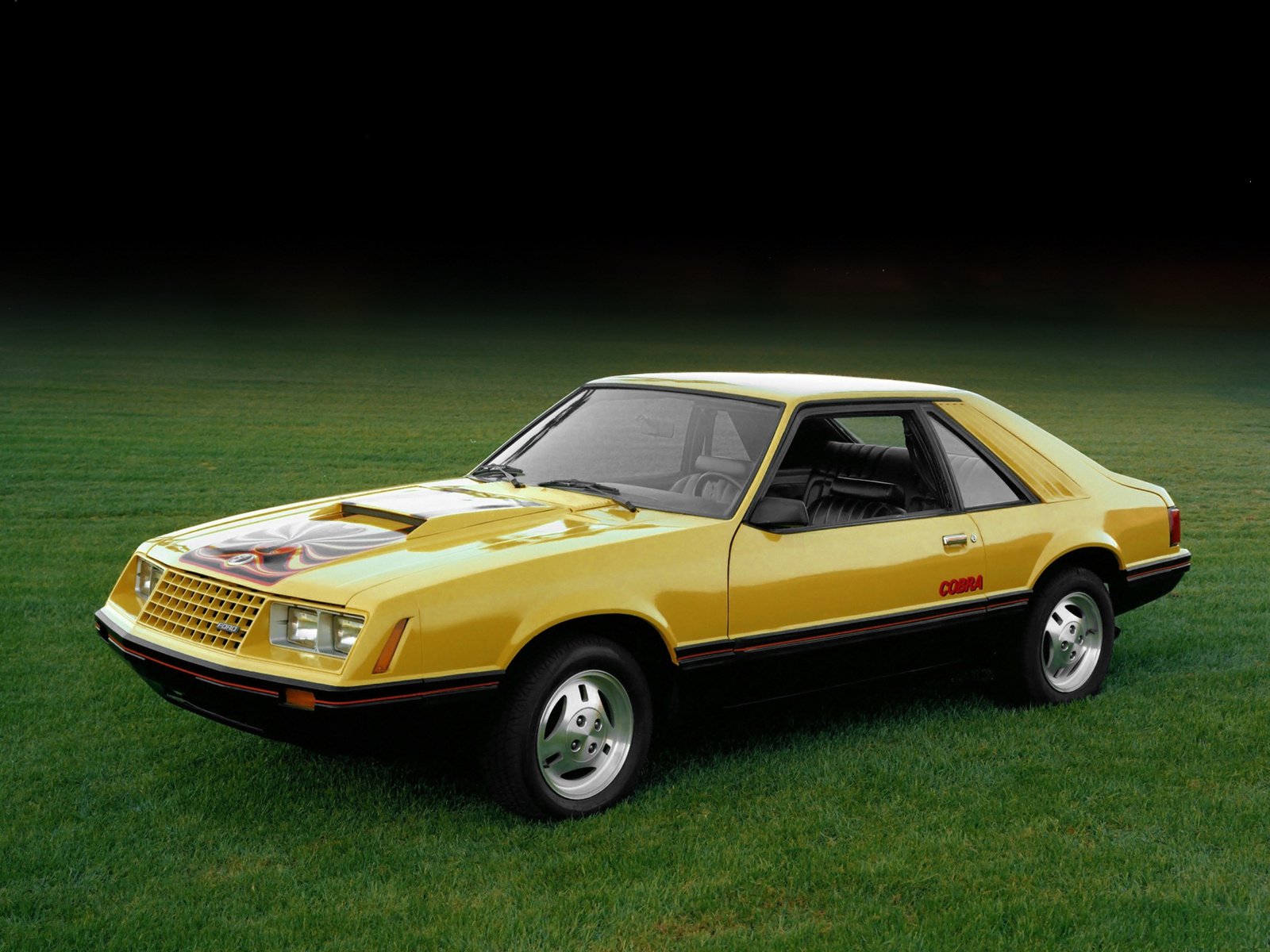
The all-new third generation Mustang arrived in 1979. It would mark the first year of the Fox chassis for Mustang. It was a complete departure from previous Mustangs and was based on the Fox-4 platform, sharing some components from the Fairmont, Capri and other Ford cars. . The only styling elements reminiscent of previous Mustangs were the long nose and short deck. Ford went to great efforts to make the third-generation Mustang a design success and possibly one of the best Mustangs ever. 1979 Mustang sales topped 369,936 units, a huge jump from the prior generation cars. The Cobra and Ghia models were carried over from the Mustang II. Mustang paced the 1979 Indianapolis 500 and new Indy pace car replica fastbacks were built to celebrate.
| Model: | 1979 Ford Mustang |
| Generation: | 3rd Generation Mustang |
| Type: | 2 Door |
| Body Styles: | Coupe, Hatchback |
| Engines: | 2.3L 2V 4 cyl, 2.3L 2V 4 cyl turbo, 2.8L 2V V6, 3.3L 1V 6 cyl, 5.0L 2V V8 |
| Original Price: | $4,494 (Basic Coupe), $4,828 (Hatchback) |
| Units Produced: | 369,936 |
Additional 1979 Mustang Research: 1979 Research Center / Colors Details / Production Numbers / Prices & Options / Sales Brochures / Owner Manuals / Maintenance / Pictures / Videos / VIN Decoder / Special Editions
Background & Details
Ford shook things up again this year. A completely redesigned Mustang body to replace the old 1974-78 Mustang II. As usual, you cannot please everyone. Many complained and are still complaining that the “New” Mustang did not resemble the old Mustang. In fact it did not hold on to enough of the body styling that you could tell one car on the road from another. The good thing is it was a change, to some people, change is bad. The body changes were complete and unique! The whole car changed as it had done in 1974. The wheelbase was increased 4.2 inches. This was done to provide additional space in the interior.
The Fox Body
Based on the Ford Fairmont, the ‘Fox’ body would be the longest running platform in Mustang history. As an example, the doors of a 1979 can be interchanged wîth those of a 1993. The Fox body also brought modern design and a renewed commitment to performance.
Originally designed for the 1978 Fairmont, the Fox platform would prove to be a good fit for Mustang, as every pony car for the next quarter-century would be Fox-based. Compared with the previous Mustang 11 platform, which was based on the Ford Pinto, the lowest cost car in the Ford fleet, which made its debut in 1970, the fox body cars fared much better. The platform was newer (1978) and the suspension, even in larger cars, such as the Fairmont, received positive reviews for it’s road manners and stable rack and pinion steering when compared to many of its domestic and European competition.
Exterior Styling And Design
To say the new Mustang was different from its previous incarnation is a huge understatement. Many Mustang enthusiasts whose heart had left for greener pastures, began to take notice again of the new Fox Body Mustang. It was small but trim, looked powerful and seemed to represent more of what the original pony car had been designed to accomplish.
Three different models were offered, in various trim levels. You could buy either a three door hatchback or a 2 door sedan. Ford kept the Ghia, the Cobra, and the regular Mustang, but started to make the Cobra a performance machine (finally).
Engines & Chassis
New in 1979 was the 2.3L turbocharged 4 cylinder engine. This engine had 132 horsepower and would be used again in 1980. Also new in mid 1979 would be the 3.3 L inline six. This was the old 170 CI previously used in other vehicles. The 2.8 liter Cologne V6 was discontinued mid-year.
At the heart of any great pony car is a great engine and at the top of the heap was the 5.0 Liter V8. The 5.0L engine was a carryover from the Mustang II, with the exception of a new single serpentine belt rather than separate belts for different devices. The carburetor was a 2-Bbl. rated at 368.5 cfm (cubic feet per minute). A new, less restrictive exhaust system was used which featured cast iron exhaust manifolds and a single pipe outlet at 2.5″ in diameter.
The suspension was changed. It now used the modified Macpherson strut suspension. The rear axle used a 4 point mounting system and coil springs rather than leaf springs. A rear stabilizer bar was added with the V8 engine. If you ordered a set of Michelin TRX tires and TR390 forged wheels you also got a suspension tuned to the wheel /tire combo.
Special Edition Models & Variants
The Ghia and Cobra made came back in 1979 for another consecutive year. For the second time since its introduction, the Mustang was named the official pace car of the Indianapolis 500. New for 1979 was the special edition Indy Pace car which was well received by the public and was available with either the high output 2.3 liter turbo motor or the 5.0 liter V8 to commemorate that honor. There was also a cool prototype racer that was more concept than limited edition car called the IMSA.
Ghia
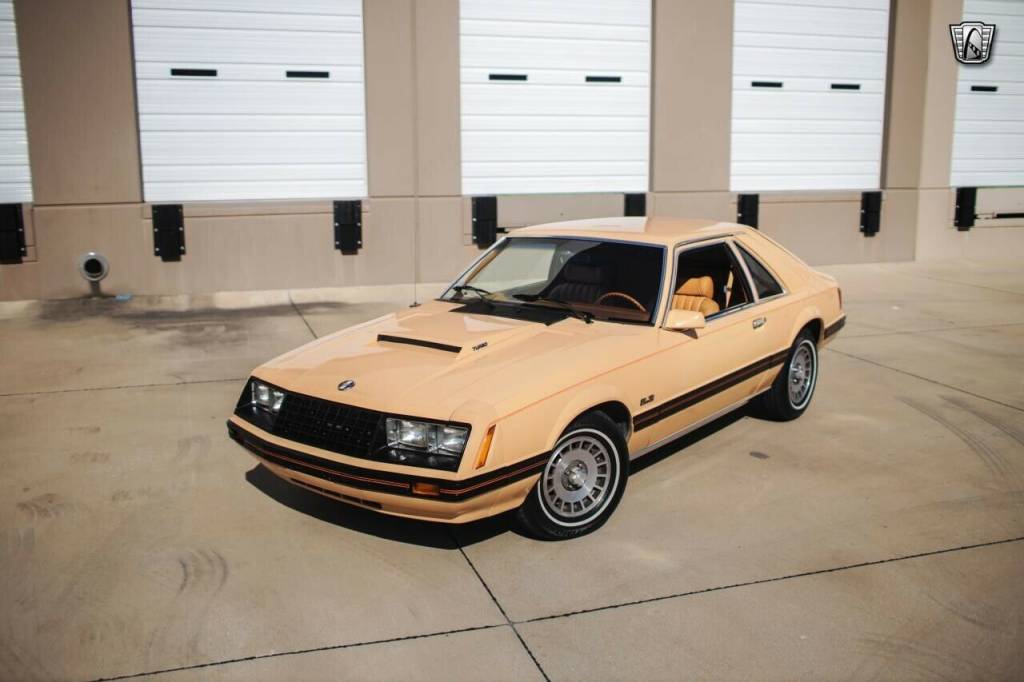
The Ghia option, which was available as a coupe (2 door) and as a hatchback (3 door) was as luxurious as ever and sported a distinctive Ghia insignia on the rear decklid or third door depending on configuration. The three door versions also has Ghia exclusive color keyed window frames, louvers and dual remote mirrors, bright belt and rocker panel moldings accented with pin stripes.
Learn more about the 1979 Ford Mustang Ghia
Cobra
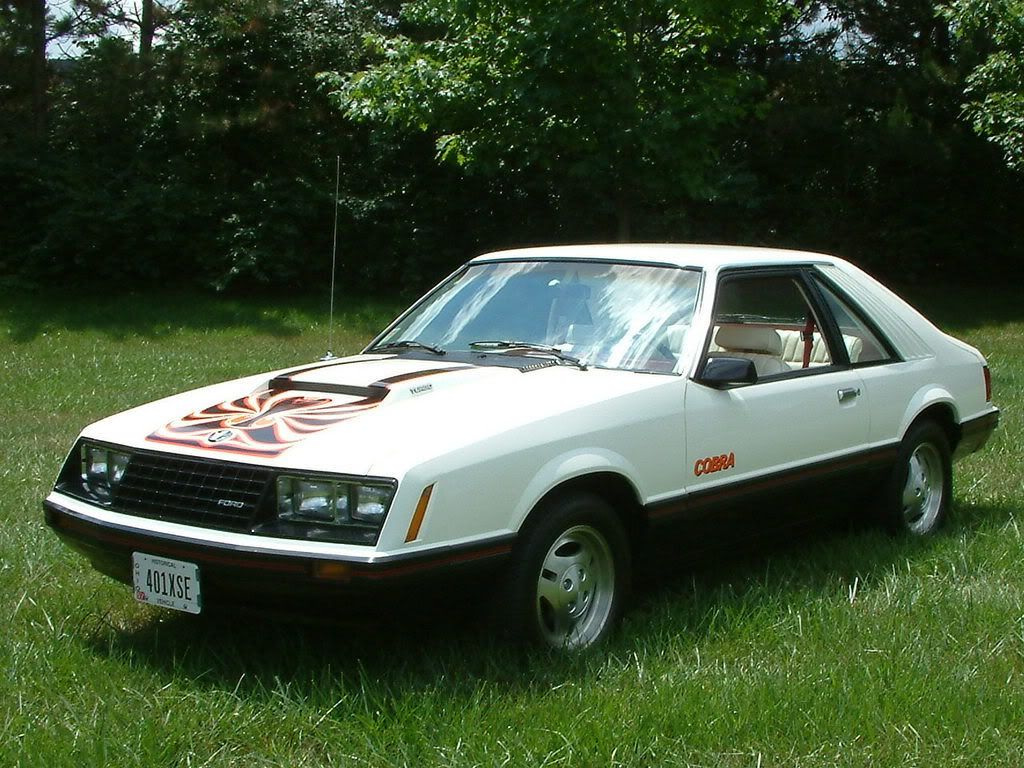
The Cobra package this year was only available with the 3 door hatchback. The standard engine was the 2.3L turbo. The only other engine available was the 5.0L V8. Either engine got the Michelin tires, forged wheels and tuned suspension.
Learn more about the 1979 Ford Mustang Cobra
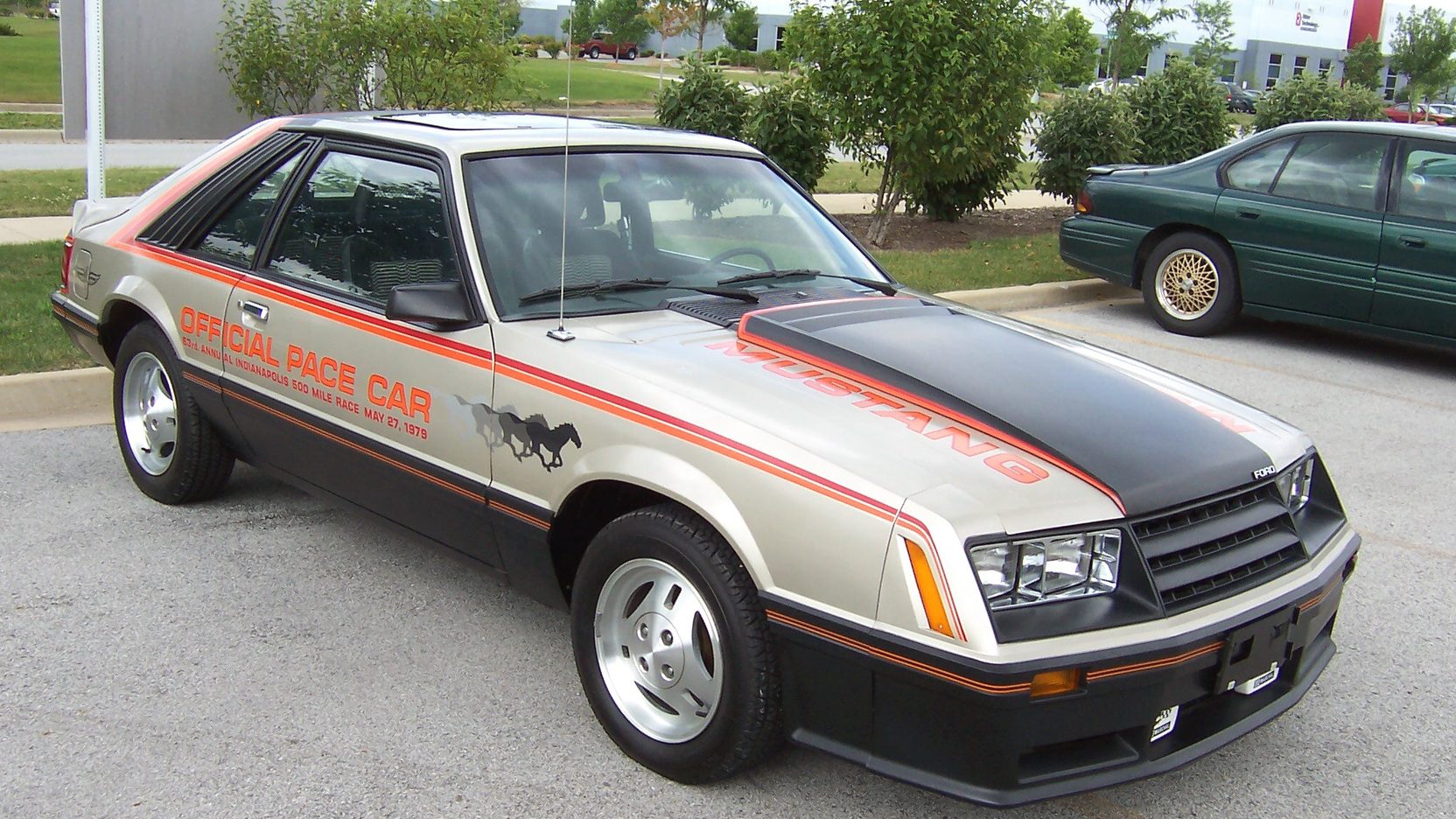
Indianapolis Pace Car
Ford built about 11000 Indianapolis Pace Car replicas in 1979 to commemorate the new Mustang bodyline and the pace car of the 1979 Indianapolis 500 race. After negotiations with the Indianapolis Motor Speedway, it was agreed that the 1979 Mustang would become the official Pace Car for the 63rd Annual Indianapolis 500 mile race. Because of the major publicity gained from the Indy 500, Ford set out 10,478 replicas of the Pace Car available to the public. These Mustangs carried much of the same uniqueness that the originals had.
Learn more about the 1979 Ford Mustang Indianapolis Pace Car
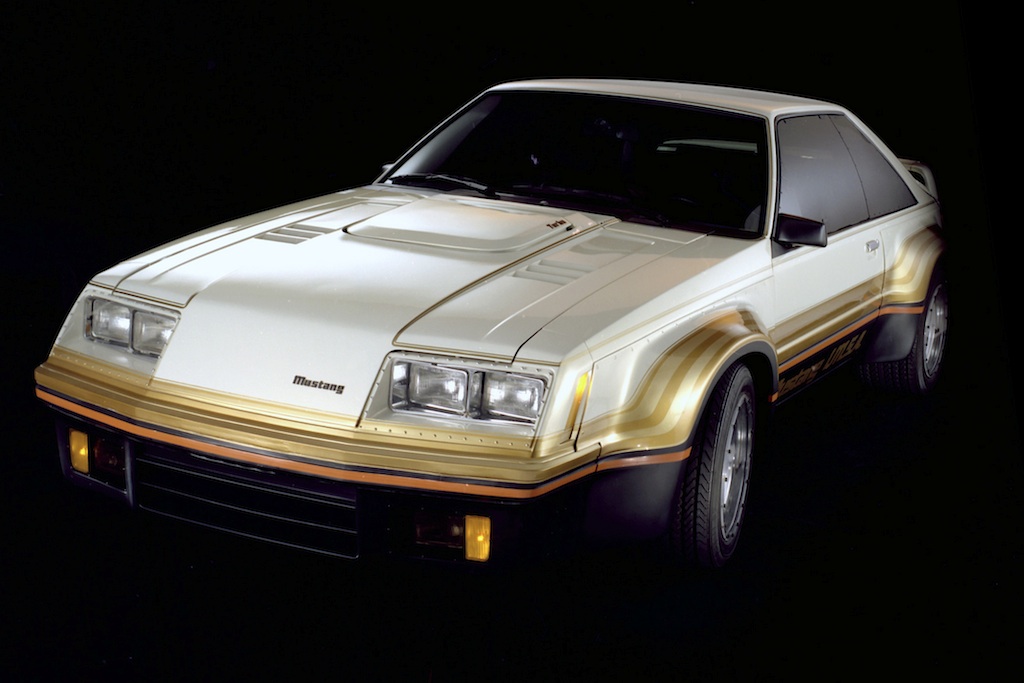
Mustang IMSA (Concept)
The 1979 Mustang IMSA (International Motor Sports Association) was a performance prototype. Elements include large 12 inch wide Gotti wheels, blanked off grille, hood louvers, rear facing shaker hood scoop, air-flow sealed headlamp trim, windows flush with outside body panels (the side windows are flip out), ten bulb rear light strip. Under the hood is a 132hp, 2.3L, turbo engine. Inside is a dark plexiglass covered instrument panel, a sport steering wheel, Recaro rally leather bucket seats. Several IMSA Mustangs were built by Ford in 1979 through the 1982 model year.
Learn more about the 1979 Ford Mustang IMSA
Specifications, Options & Detailed Stats
Production Numbers
The 1979 Mustangs were the first of the third generation Mustang. Sales were very strong for the first year of the Fox body Mustang with sales of 369,936, a 92%+ jump from the last year of the Mustang II. To dive into the model and body splits as well as see charts and percentages, check out our 1979 Ford Mustang Production & Sales Numbers deep dive.
Options and Pricing
Inflation was an issue in the U.S and Ford was faced with hiking the price of the Mustang. Base sticker prices jumped by at least 15% depending on spec. You paid $4,494 for the four-cylinder coupe and up to $5,064 for the Ghia coupe. The hatchbacks added ~$500 to that price. For more detailed options and pricing, please check out our 1979 pricing and options research.
Exterior & Interior Colors
Seven new colors were also added for the 1978 Mustang model year. For detailed colors, color palettes, codes and interior colors please check out our in depth 1979 colors information post.
Dimensions & Weight
Although the new model had a 4.2 inch longer wheelbase and was both taller and longer overall than the 1978 Mustangs they replaced, they weighed 200 lbs less!
Engine Specs
New in 1979 was the 2.3L turbocharged 4 cylinder engine and by mix-year came the newish 3.3 L inline six. The 302 V8 was largely a carryover from 1978 although it did have some improvements to be fair. For more information on engines for 1979, you can find the information here.
Performance
Below is the performance data for the 1979 Mustangs that we could find. We have included 0-60 mph times, 0-100 mph times as well as quarter mile times and top speed where available.
VIN Information
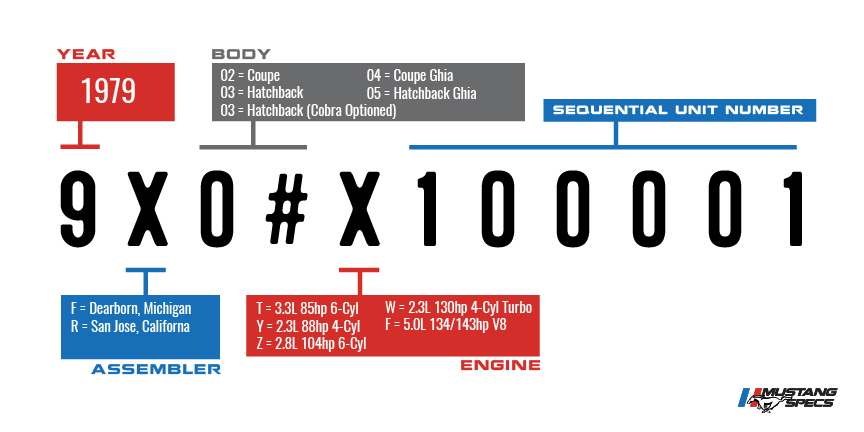
This link will take you to a page which contains the VIN tag information for all years of Mustangs. Previously this information appeared on each Mustang’s year page, but consolidating it has significantly reduced page loading times. To decode the build sheet, check out our 1979 VIN & Data Plate Decoder sheet.
Videos & Picture Galleries
We managed to find some great video reviews of the 1979 Mustang so definitely check those out. We also have a picture 1979 Ford Mustang Picture Gallery and photos of real Mustangs in each color that was available.