

The Ford Mustang’s history is usually told through its seven production generations, from the original 1965 model to today’s S650. But the evolution of one of America’s most recognizable nameplates cannot be fully understood by looking only at production cars. Between major generations, Ford repeatedly built complete concept vehicles to test radically different interpretations of the Mustang.
Some were close previews of future production cars. Others deliberately pushed the Mustang into territory Ford ultimately decided not to pursue. Together, they reveal how the Mustang evolved from a compact American sports-car idea into a global performance brand.
This is a history of the actual Mustang concept cars, excluding ordinary styling studies, clay proposals and production models.
1962 Ford Mustang I: Where the Story Began
The 1962 Mustang I was the concept that gave Ford’s new sporting-car program its identity.
Unlike the production Mustang introduced two years later, the Mustang I was a lightweight, two-seat roadster with a mid-mounted 1.5-liter V4. Developed under the direction of Ford product planner Donald Frey and designer Eugene Bordinat, it was intended to investigate the possibility of a compact, affordable American sports car.
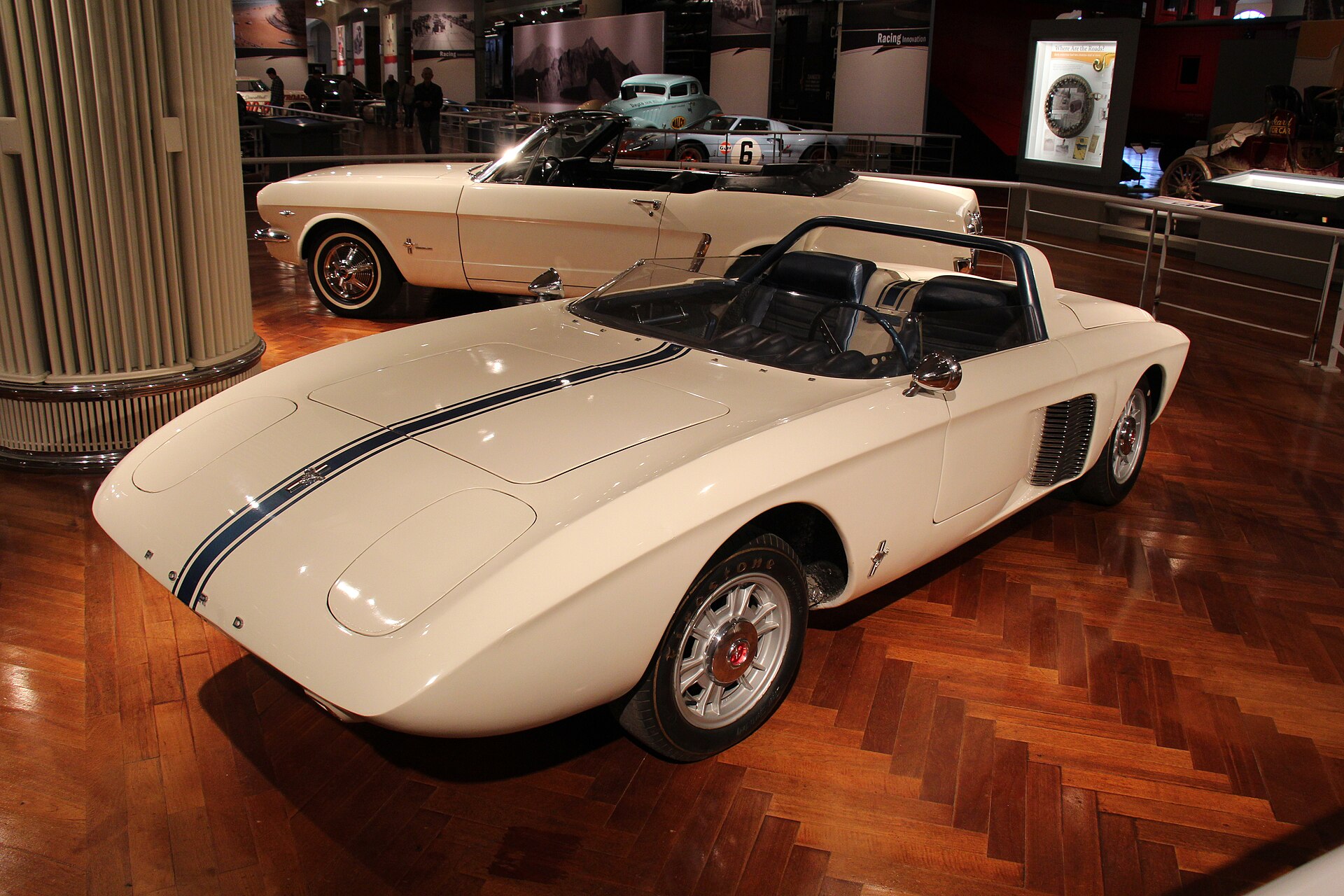
The Mustang I made its public debut at Watkins Glen in October 1962, where Formula One driver Dan Gurney demonstrated the running prototype. Ford subsequently toured the car extensively, using it to gauge public reaction to the idea of a small, youthful performance automobile.
Mechanically, very little of the Mustang I survived into production. The final Mustang would use a conventional front-engine, rear-wheel-drive layout, provide seating for four and share components with Ford’s compact Falcon.
Its conceptual contribution was much more important than its mechanical architecture.
The Mustang I established the basic idea of a small, sporty, attainable Ford designed to appeal to younger buyers. It was the starting point from which the production Mustang emerged.
1963 Ford Mustang II: The Concept Becomes a Production Formula
If the Mustang I established the idea, the 1963 Mustang II transformed it into something Ford could actually sell.
The Mustang II was substantially closer to the production automobile than its predecessor. Ford had concluded that the new model needed to be more practical than a two-seat sports car. The concept therefore moved toward the configuration that would define the Mustang: a front-engine, rear-wheel-drive vehicle with room for four occupants.
The transformation was fundamental.
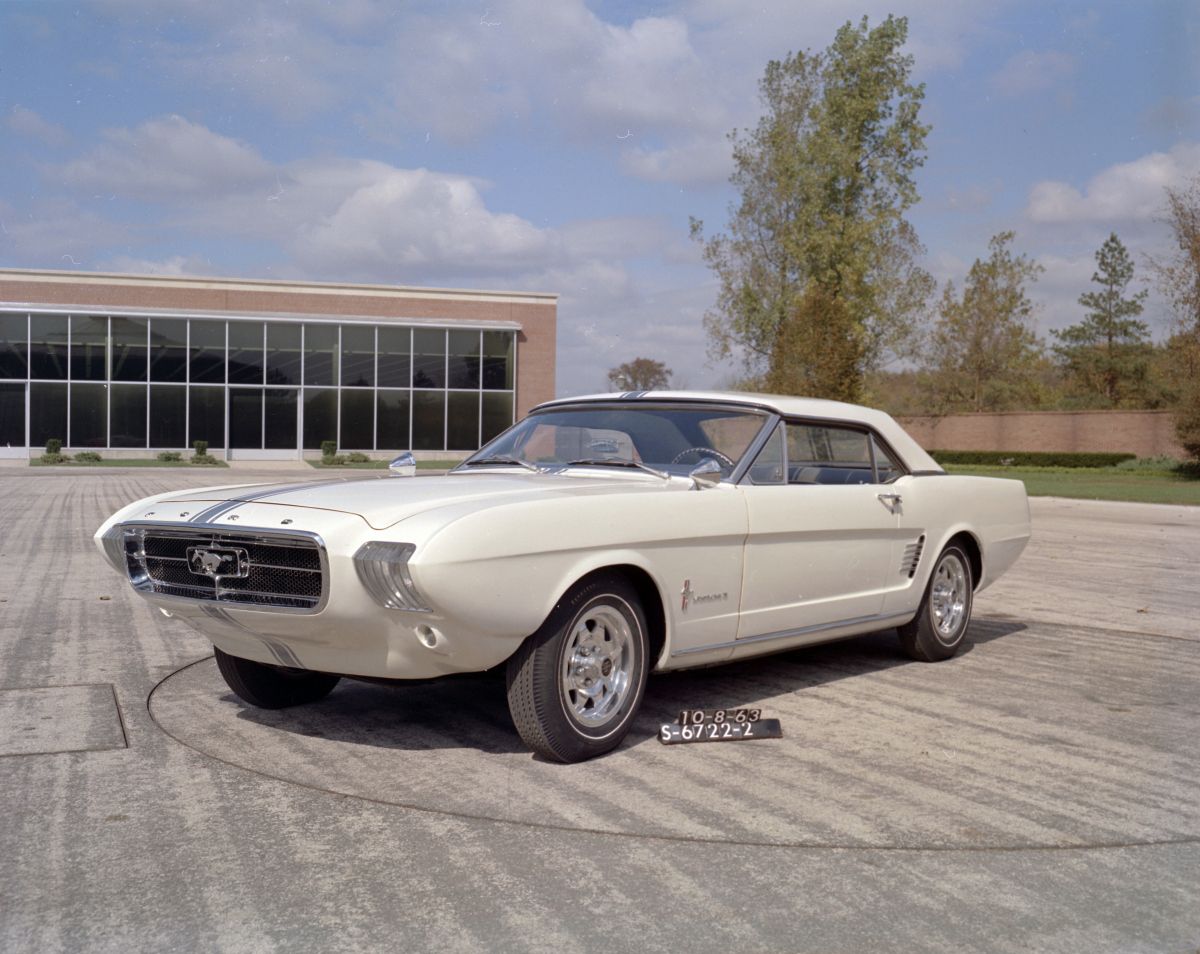
Ford was not attempting to build an American equivalent of a European roadster. Instead, it was creating a new category of affordable sporty car—one combining compact dimensions, attractive styling, available V8 power and everyday usability.
That combination became the foundation of the pony-car segment.
The production Mustang that debuted at the New York World’s Fair in April 1964 was recognizably descended from this concept. The Mustang II therefore represents the point at which the Mustang stopped being merely an experimental sports-car project and became a viable production concept.
1966 Ford Mustang Mach I Concept: Exploring a More Aggressive Mustang
Ford’s 1966 Mustang Mach I Concept demonstrated that the Mustang could evolve toward a much more aggressive visual identity.
Presented at the 1966 Detroit Auto Show, the concept pushed the Mustang’s styling beyond the relatively restrained appearance of the original production car. It featured a dramatic fastback profile and more pronounced performance-oriented design elements.
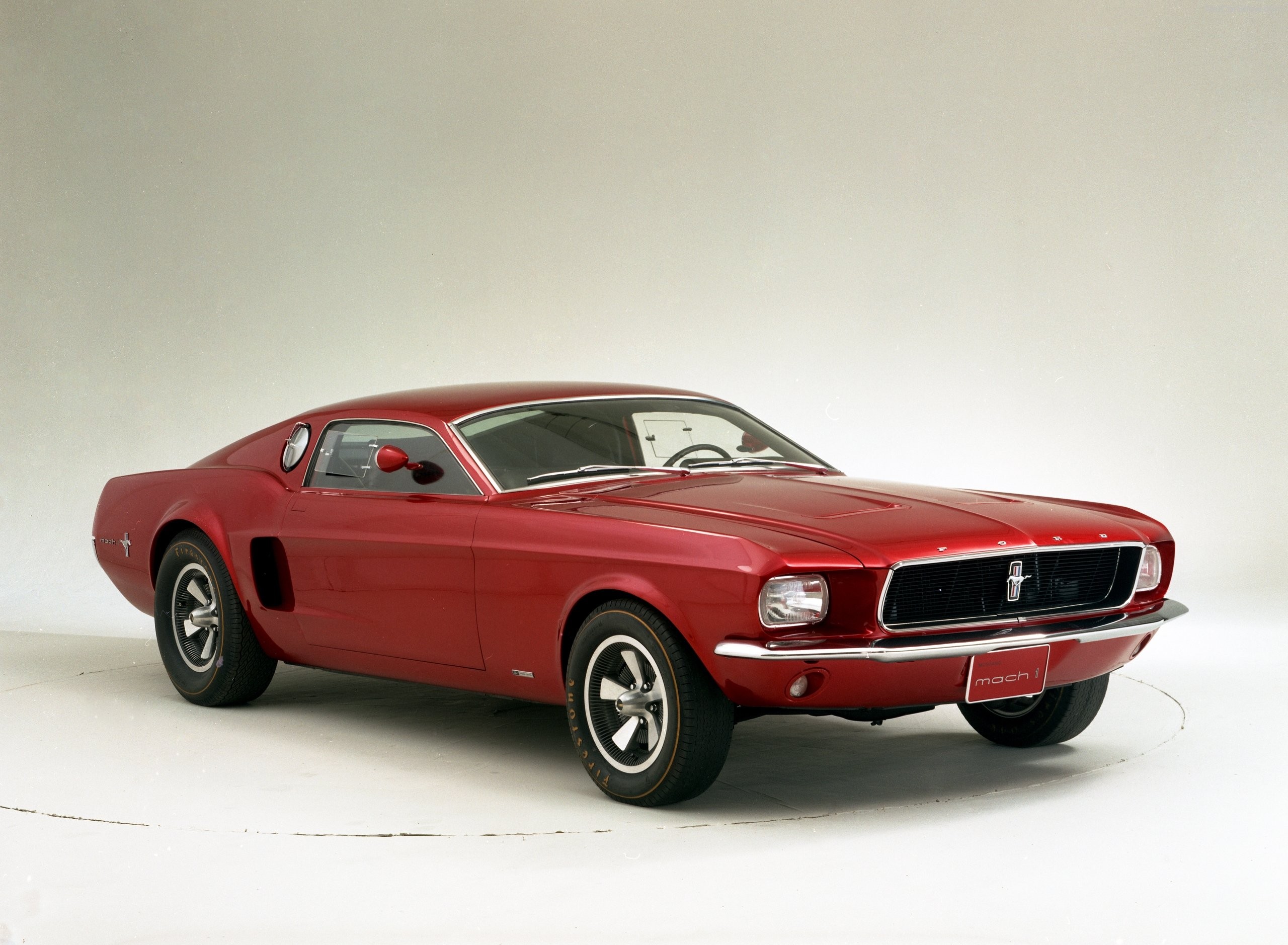
The concept was not the production Mach 1 that would arrive for 1969. The names are related, but the vehicles should not be confused.
The 1966 Mach I was a design concept, intended to explore where Mustang styling could go. Ford subsequently incorporated elements of its design thinking into later Mustang development, including the second-generation-era Mustang styling direction.
The concept was important because it demonstrated an increasingly influential idea within Mustang development: performance could be communicated visually as well as mechanically.
The Mustang did not have to be merely a sporty compact car. It could become an aggressive performance machine.
1970 Ford Mustang Milano: Preparing for a Bigger Mustang
The Mustang Milano represented Ford’s vision of where Mustang could go at the beginning of the 1970s.
Unveiled at the 1970 Chicago Auto Show, the Milano was a dramatically styled two-seat concept with an exceptionally low roofline, long hood and sharply defined fastback body. Its proportions were considerably more extreme than those of the production Mustang.

The concept also incorporated technology that was futuristic for the period. Among its unusual features were electronically operated body components and tail lamps capable of displaying different colors depending on the vehicle’s operating condition.
The Milano was not intended to enter production in its concept form. Its importance instead came from its relationship to the next stage of Mustang design.
The production 1971 Mustang became significantly larger, more muscular and more visually dramatic than the original pony car. The Milano demonstrated that Ford was already exploring this fundamental change.
It therefore stands as an important visual bridge between the compact first-generation Mustang and the larger, more imposing Mustangs of the early 1970s.
1980 Ford Mustang RSX: Mustang Goes European
The 1980 Mustang RSX took Mustang in an entirely different direction.
Developed by Ford’s Ghia design studio in Italy, the RSX—short for Rallye Sport Experimental—was a compact, two-seat interpretation of the Fox-body Mustang. Its wheelbase was shortened, its body substantially altered and its styling given a distinctly European flavor.
The concept combined Mustang proportions with elements associated with European sporting cars, including a compact cabin, aggressive aerodynamic treatment and a highly focused two-seat configuration.
Power came from a 2.3-liter four-cylinder engine paired with a four-speed manual transmission.

The RSX was never intended to become the next production Mustang. Instead, it demonstrated how dramatically the Fox-body architecture could be reinterpreted.
That experimentation was particularly significant because Ford was navigating a radically different automotive environment. Fuel economy, emissions regulations and changing consumer expectations had forced Mustang to become smaller and more efficient.
The RSX showed one possible future: a lighter, more compact and internationally influenced Mustang.
Ford ultimately chose a different path, but the concept remains one of the most revealing Mustang experiments of the early Fox-body era.
1993 Ford Mustang Mach III: The Road to the SN95
The 1993 Mustang Mach III was one of the most consequential Mustang concepts ever built.
Unveiled at the 1993 Detroit Auto Show, the Mach III arrived as Ford was preparing the successor to the long-running Fox-body Mustang. Its appearance represented a dramatic departure from the angular styling of the previous generation.
The concept featured a low, rounded body, two-seat configuration, muscular fenders and distinctive side scoops. Beneath the body was an equally ambitious powertrain: a supercharged 4.6-liter DOHC V8 producing approximately 450 horsepower, connected to a six-speed manual transmission.

Ford did not simply copy the Mach III for production. The final fourth-generation Mustang retained four seats and adopted a considerably more practical body.
But the concept’s influence was unmistakable.
Several elements—including the side scoops, front-end treatment and lighting themes—found their way into the 1994 Mustang.
The Mach III therefore represents an important lesson in concept-car development. A successful concept does not necessarily preview an entire production vehicle. It can instead identify individual design and engineering themes that designers can translate into a feasible automobile.
2003 Ford Mustang Concept: Reinventing Mustang Through Its Heritage
The 2003 Mustang Concept changed the trajectory of Mustang design more profoundly than almost any concept since the Mustang II.
Ford’s designers looked backward to move the Mustang forward.
The concept deliberately incorporated visual references to the original 1960s Mustang: a long hood, short rear deck, pronounced rear shoulders, a strong grille and unmistakable fastback proportions. But these cues were not reproduced literally. They were reinterpreted using contemporary surfaces and proportions.
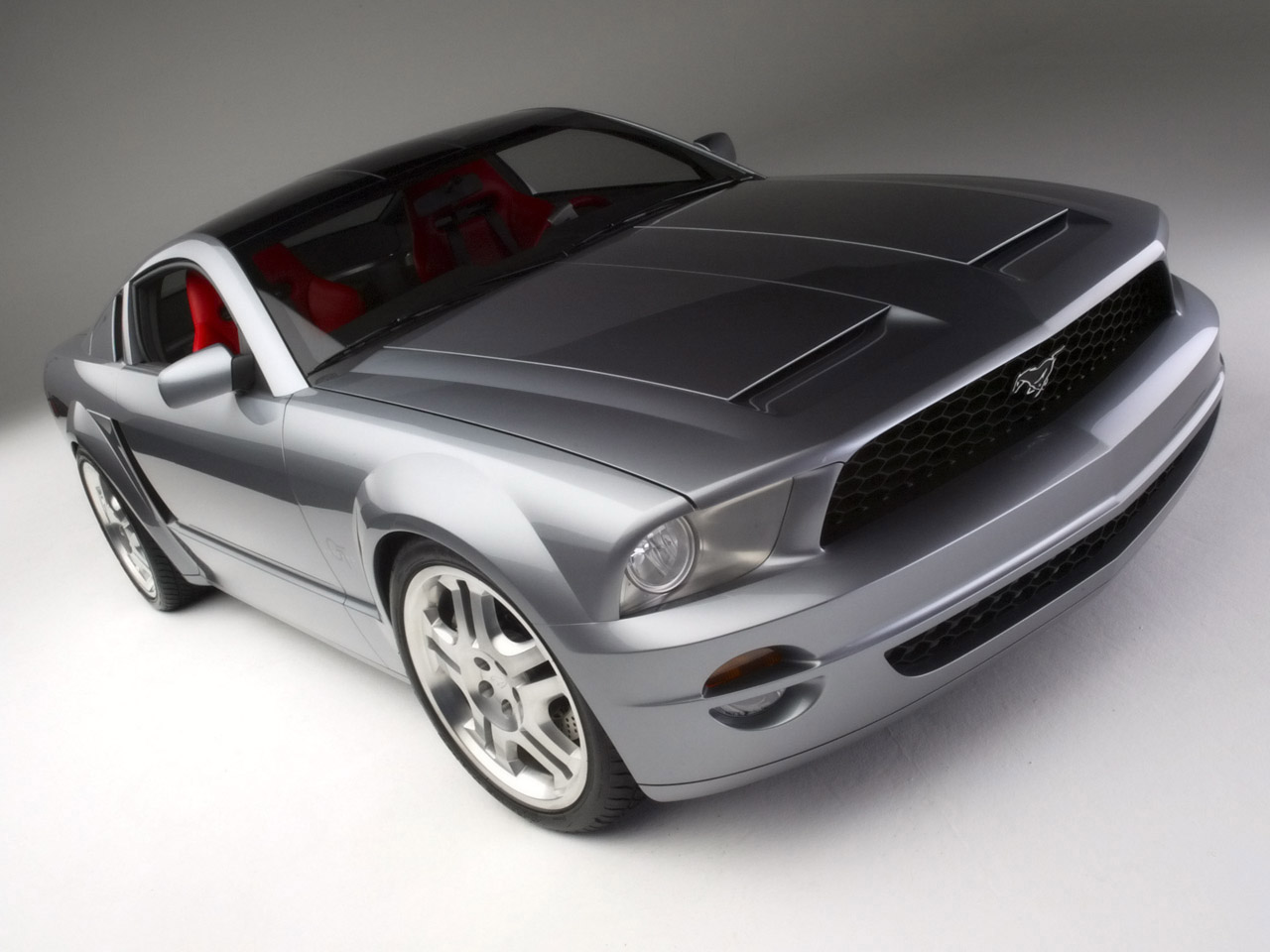
The result became the foundation for the 2005 fifth-generation Mustang.
This was a critical moment in Mustang history because Ford effectively established retro-modern styling as a permanent part of the nameplate’s visual vocabulary.
Instead of treating the past as something Mustang had outgrown, Ford turned its heritage into a design asset.
The production S197 retained the concept’s fundamental proportions and muscular stance, while modernizing the chassis, interior and powertrains.
The 2003 concept consequently did more than preview a new Mustang. It established a design philosophy that would influence the nameplate for the next two decades.
2006 Ford Mustang by Giugiaro: An American Icon Reinterpreted
The Mustang by Giugiaro offered one of the most radical interpretations of the fifth-generation Mustang.
Created by Italian design firm Italdesign Giugiaro and unveiled at the 2006 Los Angeles Auto Show, the concept retained the fundamental Mustang identity while transforming virtually every exterior surface.
The front fascia was sharper, the body sides heavily sculpted and the greenhouse dramatically revised. A large glass roof further changed the character of the car.
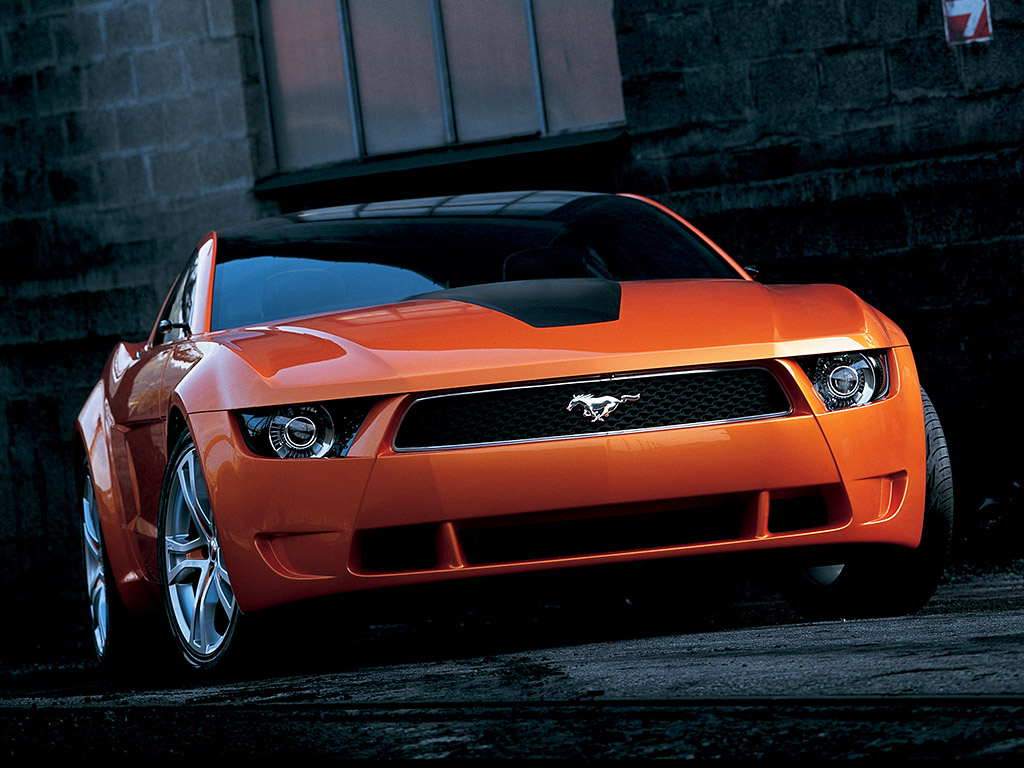
Ford also gave the concept genuine performance hardware. A supercharged 4.6-liter V8 provided the power, reinforcing the idea that the Giugiaro Mustang was not merely a styling exercise.
Yet the concept remained unmistakably Mustang.
That balance was important. Giugiaro demonstrated that the Mustang could be dramatically redesigned without abandoning the visual characteristics that made the nameplate recognizable.
The car was never intended for production, but it became an influential example of Mustang’s potential as an international design object rather than simply an American domestic product.
2022 Ford Mustang GT3 Concept: Mustang Enters a New Racing Era
The Mustang GT3 Concept represents a different chapter in the history of Mustang concepts.
Rather than previewing a conventional road car, it presented Ford’s vision for the next generation of Mustang-based global GT racing machinery.
Revealed alongside the seventh-generation Mustang program, the GT3 concept featured extensive aerodynamic modifications, a race-oriented chassis and bodywork designed around international GT3 regulations.

Its significance extends beyond motorsport.
For decades, Mustang performance had been represented by increasingly specialized road cars and racing derivatives. The GT3 program demonstrates how Ford now treats Mustang as a global performance platform capable of competing at the highest levels of customer-based GT racing.
The concept also arrived at the same time Ford was developing the S650 Mustang, linking the road-going seventh generation with a dedicated international competition program.
The Concepts That Shaped Mustang
Ford repeatedly used Mustang concepts to test the boundaries of the nameplate—sometimes by making it smaller, sometimes larger, sometimes more practical, sometimes more exotic and sometimes considerably more performance-focused.
Most importantly, the concepts reveal that the Mustang’s identity has never been completely fixed.
The production cars are the chapters most people remember, but the concepts reveal the decisions Ford could have made along the way. They show the alternative futures that were considered before the company committed to a particular generation.
From the mid-engine Mustang I of 1962 to the race-bred GT3 concept six decades later, the story is therefore one of continuous reinterpretation.
The Mustang survived—and remained recognizable—not because Ford refused to change it, but because its designers repeatedly found new ways to change the car without abandoning the fundamental idea that made the Mustang possible in the first place.