

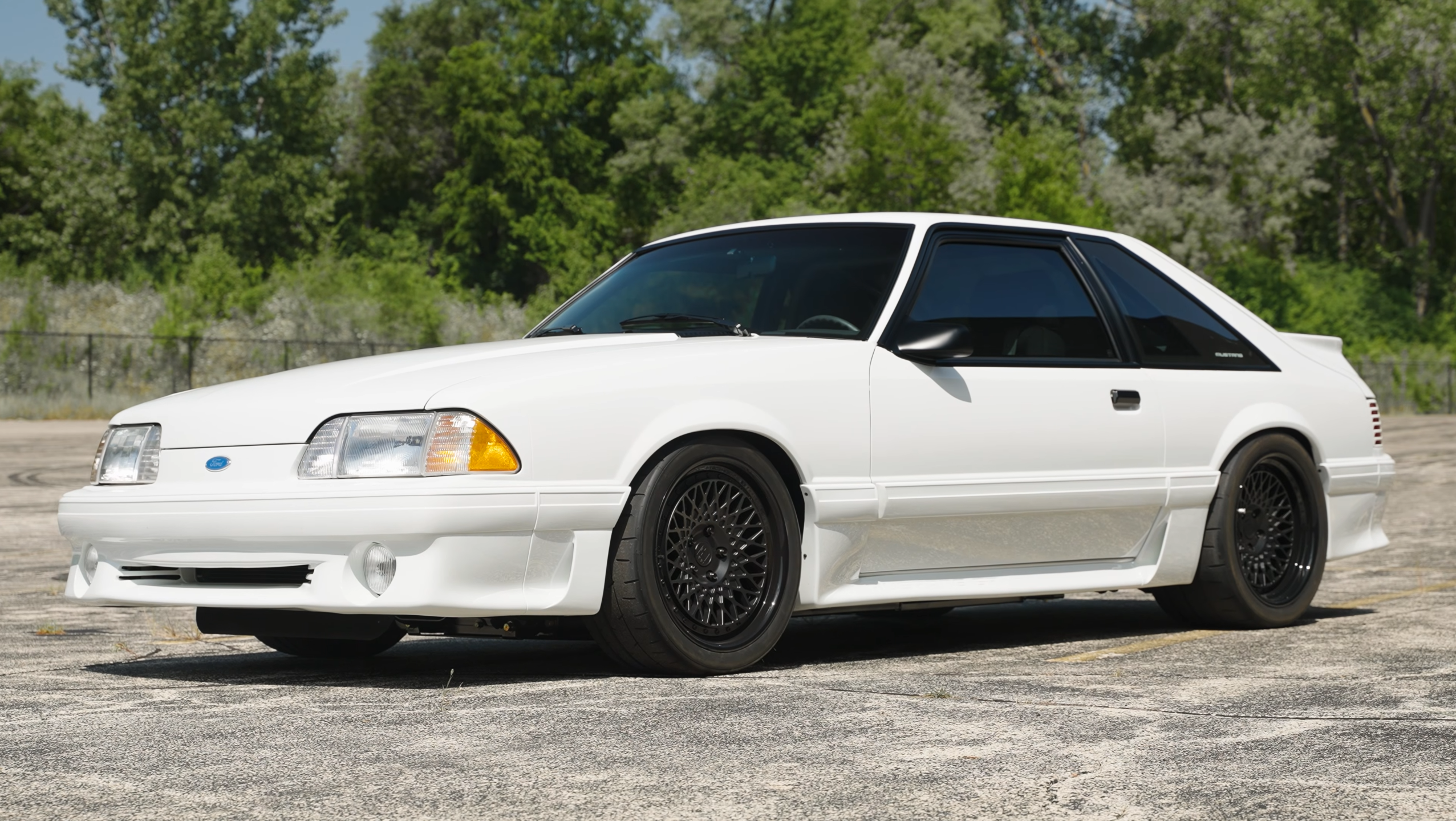
The Fox body Mustang has long occupied an important place in American performance-car culture, but Roadster Shop’s latest interpretation demonstrates just how far the platform can be pushed without sacrificing its original character. Featured by Autotopia LA during a visit to Roadster Shop, the car is based on an exceptionally low-mileage 1989 Mustang GT and combines its largely original appearance with a thoroughly modern mechanical package.
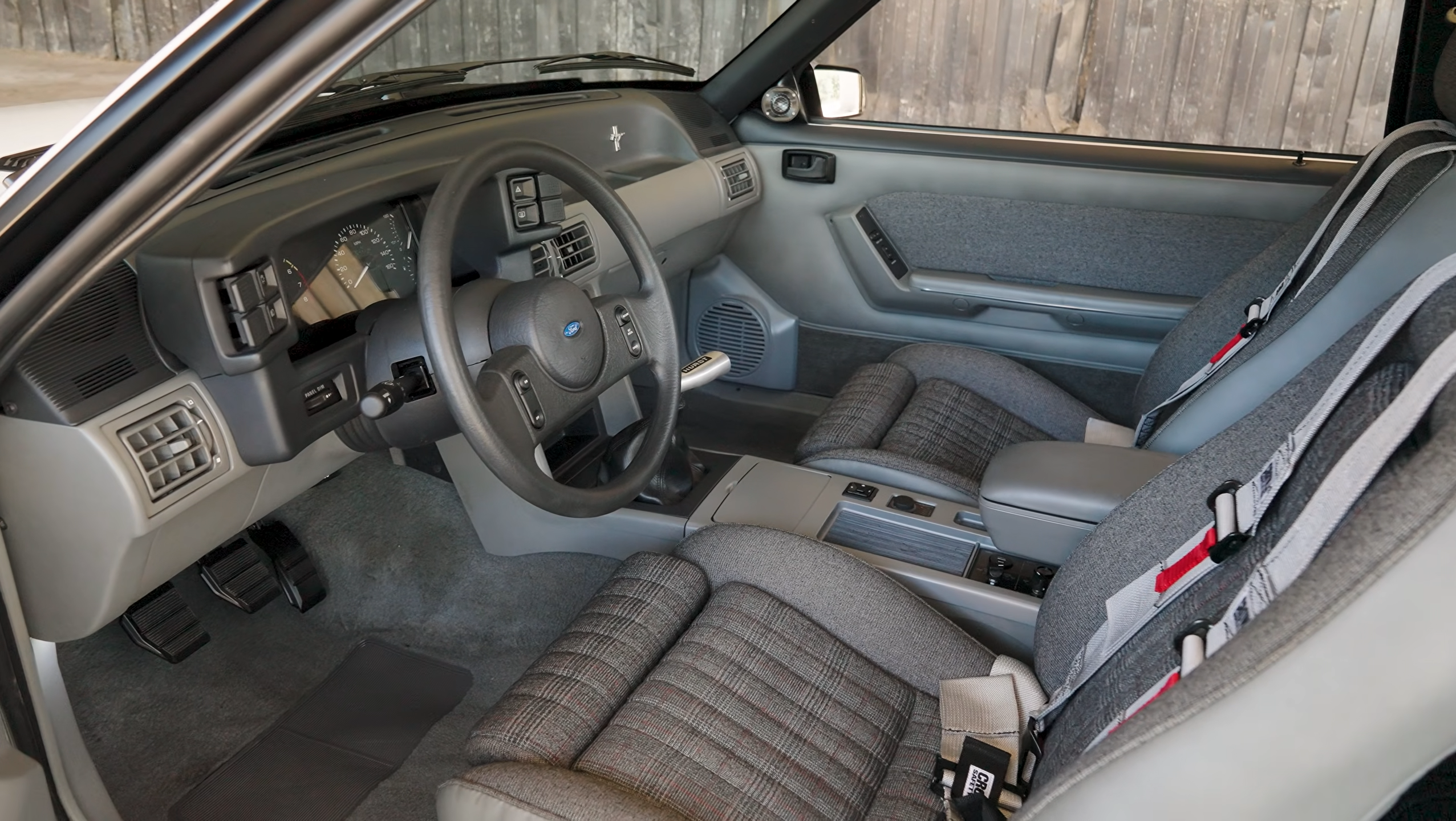
At first glance, the car remains remarkably faithful to the Fox body formula. The exterior is essentially stock, retaining the proportions and styling that defined the late-1980s Mustang GT. Even much of the interior remains original, including the factory seats and steering wheel. Underneath, however, almost everything that determines how the car drives has been reconsidered.
A Bolt-On Chassis Foundation
The foundation of the build is Roadster Shop’s Fox body chassis system. Rather than requiring the complete replacement of the factory unibody, the system is engineered as a front-to-rear bolt-on structure that integrates with the original shell. The approach allows the factory body to remain intact while providing a substantially more capable structural and suspension platform.
Roadster Shop also developed bolt-on panels and overlays to clean up the engine bay without permanently altering the original structure. Even areas such as the firewall and core support can be visually refined using components that fasten over the existing sheet metal. The result is an engine compartment that looks purpose-built while maintaining the reversibility and practicality of the chassis concept.
NASCAR-Inspired Naturally Aspirated Power
The centerpiece of the Mustang is its naturally aspirated 434-cubic-inch Windsor V8. Built around a Dart block and fitted with D3 NASCAR heads, the engine takes the traditional small-block Ford concept into considerably more serious territory.
The specification includes titanium valves, billet shaft rockers, a one-off intake designed and machined by Wagner Motorsports, and a custom-machined valve cover. A dry-sump lubrication system supports the engine’s high-rpm operating capability, allowing it to reach approximately 8,800 rpm.
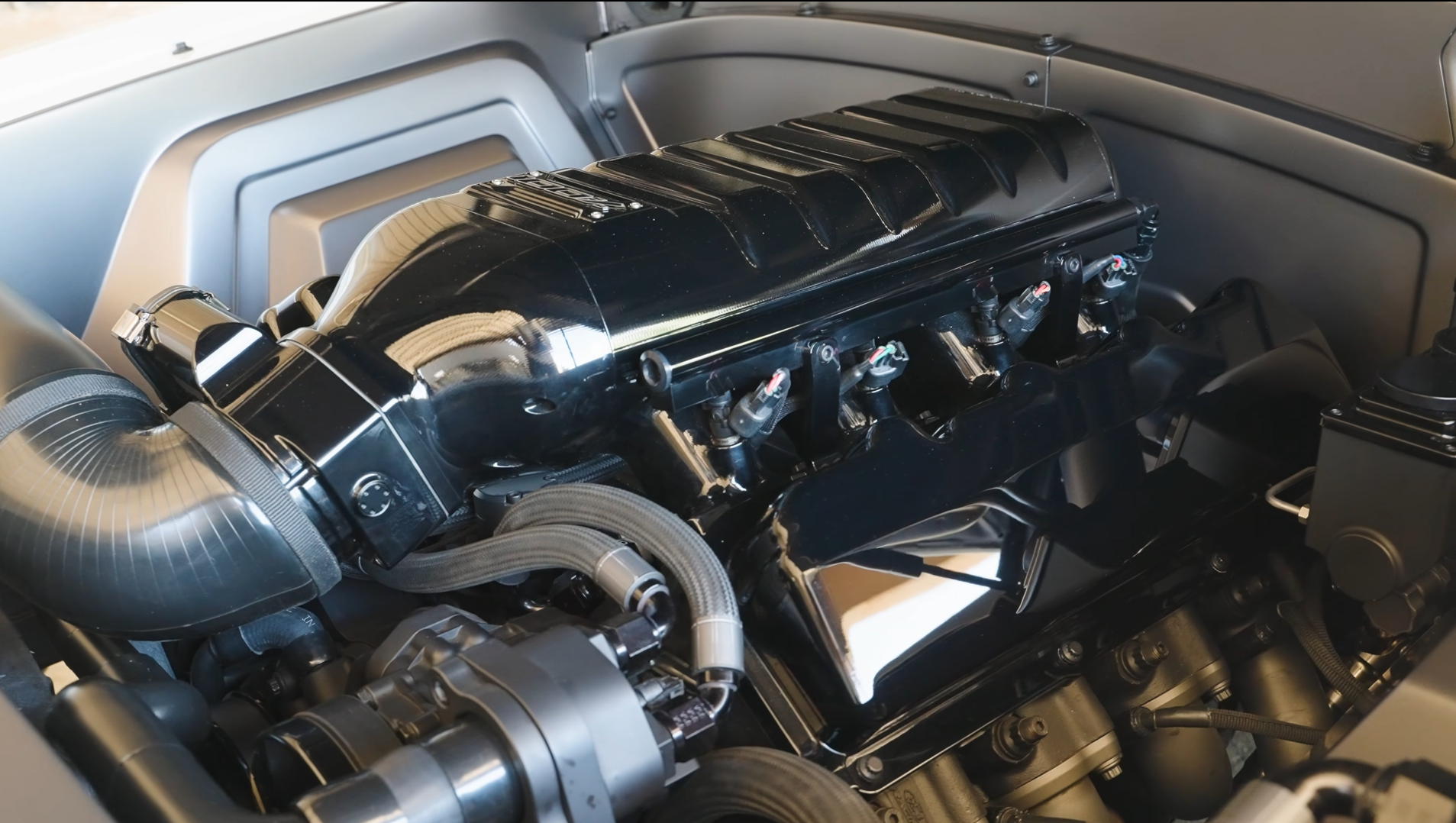
According to Roadster Shop, the engine produces roughly 800 hp on pump gasoline.
Rather than relying on turbocharging or supercharging, the combination delivers its performance through displacement, cylinder-head technology, engine speed, and naturally aspirated breathing. That distinction is central to the car’s character. The linear response of the V8 gives the driver a direct relationship between throttle input and acceleration, without waiting for boost to build.
Adding another layer of character are the custom 2-inch-primary 180-degree headers. Their configuration crosses beneath the engine and is designed to pair the exhaust pulses in a way that improves scavenging while producing a distinctive high-rpm exhaust note.
T-56 Manual Transmission and Ford 9-Inch Rear
Power is transmitted through a Bowler T-56 six-speed manual transmission, paired with a carbon-fiber driveshaft and a Ford 9-inch rear axle. The rear end uses 3.90:1 gearing and a Wavetrac limited-slip differential, giving the Mustang the gearing and traction hardware necessary to exploit its high-revving V8.
The transmission is complemented by a short-throw shifter and a period-inspired T-handle, deliberately retaining some of the tactile character associated with the original Fox body. The result is a drivetrain that combines modern strength with an interface that feels appropriate to the car’s era.
Roadster Shop also replaced the Mustang’s original clutch arrangement with a custom billet pedal assembly incorporating a Tilton 3/4-inch master cylinder. The hydraulic system is packaged beneath the dashboard and uses a dedicated reservoir arrangement designed to keep the installation compact and serviceable.
Electronically Controlled Suspension
One of the most significant departures from the original Mustang is the suspension system. Roadster Shop equips the car with electronically controlled coilovers connected to a standalone ECU and rotary control interface.
The system provides both passive and adaptive operating modes. In passive operation, the driver can select comfort, sport, or race settings. Adaptive operation goes further by allowing the system to react dynamically to vehicle behavior, adjusting damping as the car brakes, accelerates, and corners.
The objective is not simply to make the Fox body stiffer. Instead, the suspension is designed to alter the car’s behavior according to driving conditions. Under hard braking, for example, the system can increase front compression and control rear rebound. During cornering, individual damping characteristics can be adjusted to provide additional support.
The effect is transformative. On the road, the car retains a compliant character in comfort mode while becoming progressively more controlled as the driver moves toward sport-oriented settings. This gives the Fox body something its original suspension architecture could never provide: a variable chassis personality.
Modern Steering and Braking Hardware
Roadster Shop also addresses another weakness of the original platform with an electronically controlled power-steering system. A standalone electric-over-hydraulic pump allows the driver to vary steering assistance manually, while the system can also be programmed to respond according to vehicle speed.
Lower assistance produces a heavier, more direct steering feel suited to aggressive driving, while greater assistance makes the car easier to maneuver at lower speeds.
Braking hardware comes from Baer, supported by a custom pedal assembly and manual-brake configuration. The objective is deliberately driver-focused: the hydraulic system provides a more direct pedal relationship rather than isolating the driver from the braking process.
Period Appearance, Modern Capability
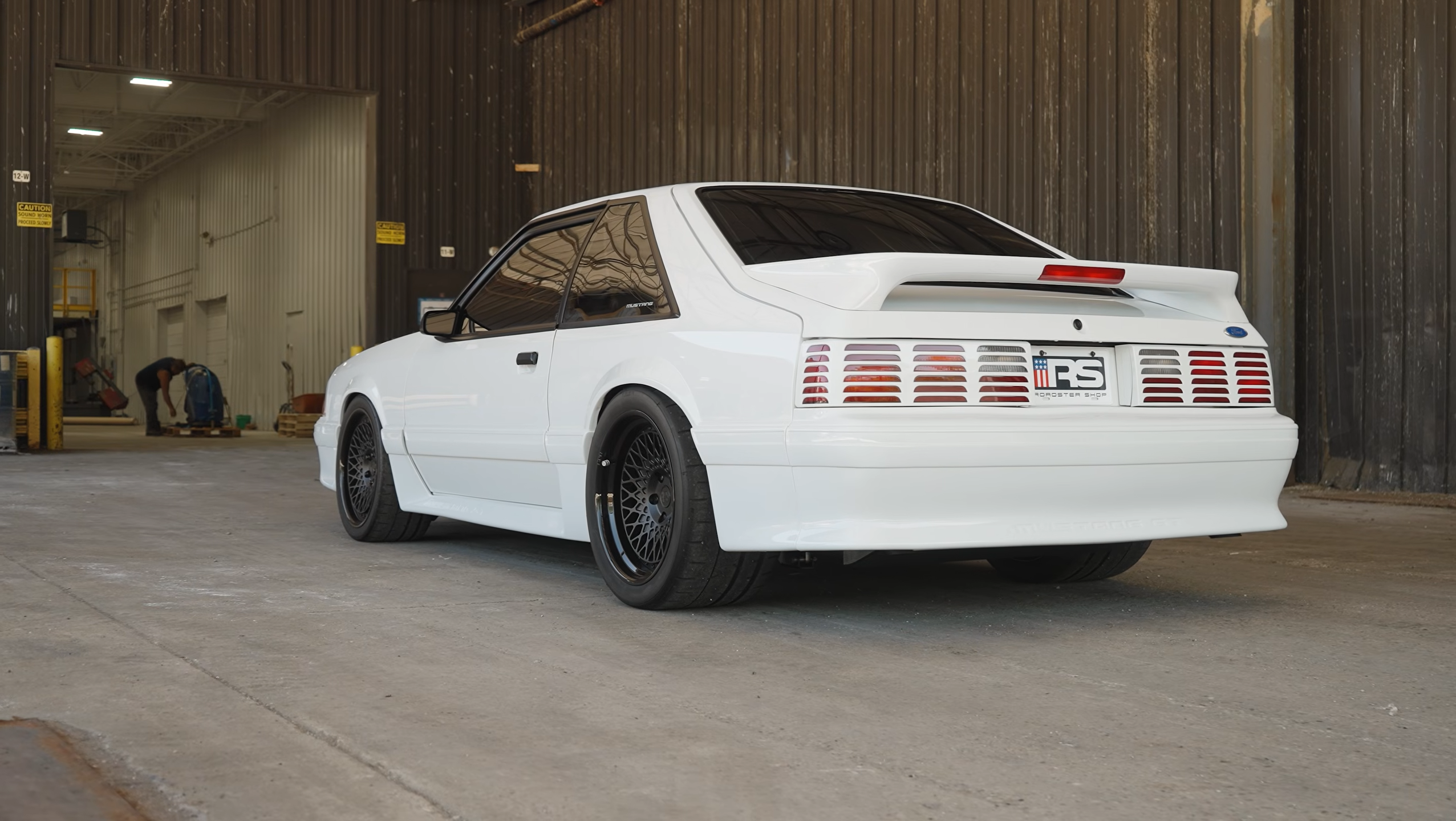
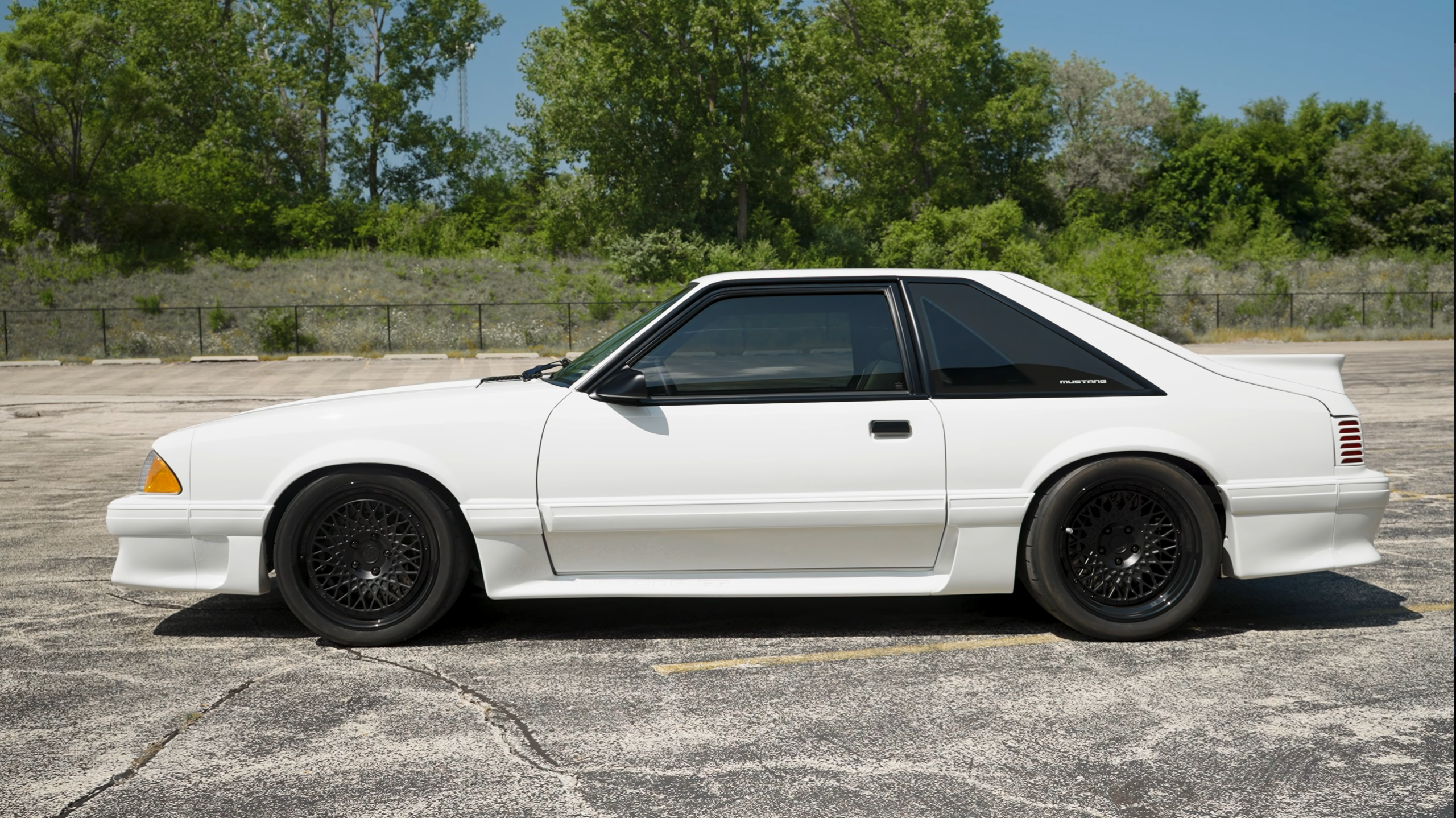
The wheels and tires reinforce the build’s restrained visual philosophy. HRE wheels measure 18 by 9.5 inches at the front and 18 by 12 inches at the rear, with 255/35R18 front tires and massive 335/30R18 rear rubber. The wheels use a satin-black center with a gloss-black hoop, giving the car an unmistakably period-influenced appearance without compromising its modern mechanical specification.
The body itself remains deliberately understated. Finished in stark white with contrasting black trim, it retains the visual identity of an ’89 Mustang GT rather than advertising the extensive engineering underneath.
The same philosophy carries into the cabin. Dakota Digital RTX instrumentation preserves the appearance of the original gauges while introducing modern electronics. Vintage Air provides climate control, while a Bluetooth-equipped Blaupunkt head unit mimics the appearance of an old cassette stereo.
Even the factory seats and steering wheel were retained because of the car’s exceptionally low mileage. The steering wheel, however, proved to be one of the few original components that did not meet the demands of the transformed chassis, illustrating the fundamental difference between an original Fox body and this modernized version.
The Driving Experience
The most compelling evidence of the engineering comes once the Mustang leaves the workshop. Autotopia LA’s road evaluation demonstrates that the car bears little resemblance dynamically to the original Fox body.
The naturally aspirated V8 delivers immediate, predictable power, while the T-56 provides precise six-speed control and allows the driver to exploit the engine’s enormous rpm range. The electronically controlled suspension keeps the chassis composed while maintaining enough compliance for road use.
The combination is particularly effective because none of the individual systems overwhelms the others. The engine supplies approximately 800 hp, but the chassis has been engineered to manage that output. The steering can be tailored to the driver’s preference, the suspension can adapt to changing conditions, and the manual transmission keeps the driver directly involved.
That is ultimately what separates this Mustang from a conventional restomod. Roadster Shop has not simply installed a larger engine and upgraded the brakes. It has re-engineered the fundamental dynamic relationship between the driver and the Fox body while deliberately preserving the sensory identity of the original car.
The result is an ’89 Mustang GT that looks familiar but behaves like an entirely different machine. Its classic interior, understated exterior, naturally aspirated V8, six-speed manual gearbox, and advanced chassis technology form a carefully integrated package. Rather than erasing the Fox body’s character, Roadster Shop has used modern engineering to reveal what the platform can become when its structural and dynamic limitations are removed.
In that respect, the build represents the strongest form of restomod philosophy: preserve the experience that made the original desirable, then systematically eliminate everything that prevented it from delivering serious modern performance.
Source: Autotopia LA