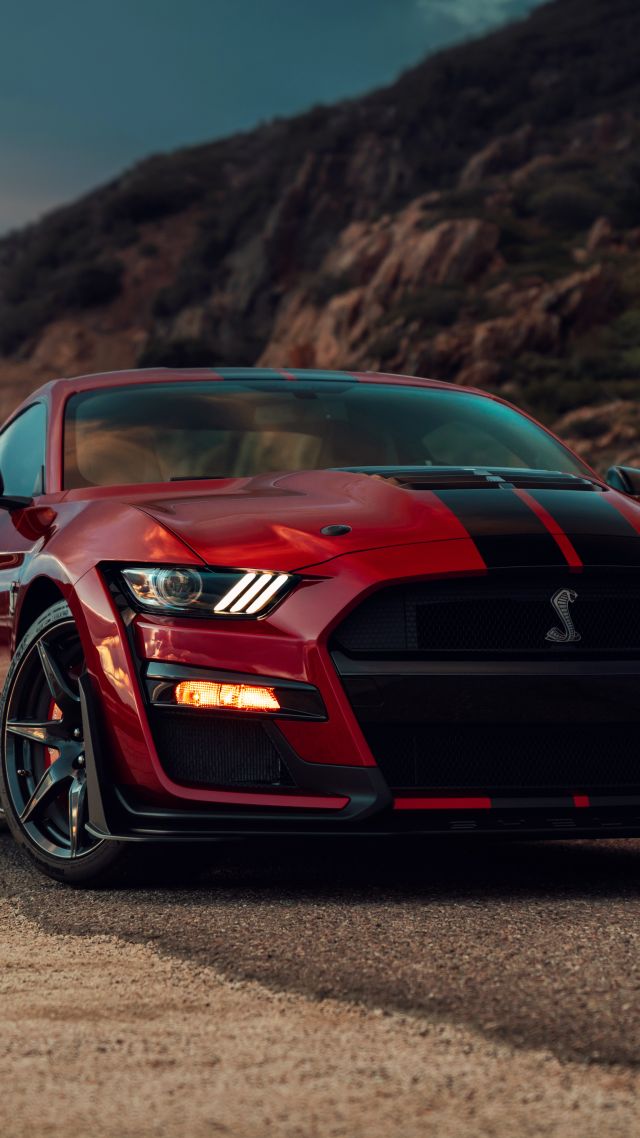

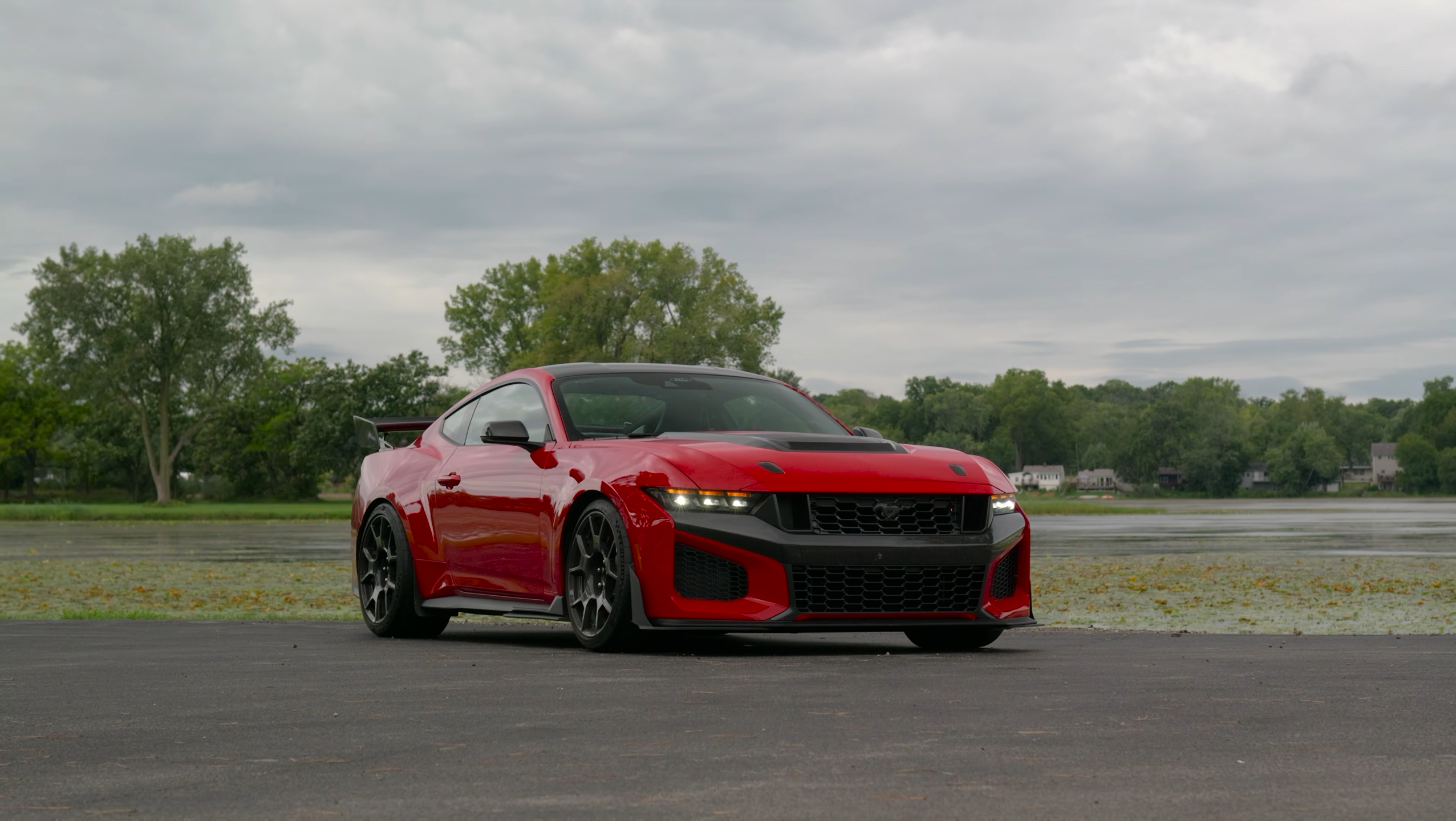
Ford’s Mustang Dark Horse SC represents a significant change in how the company approaches its highest-performance pony cars. Rather than simply adding horsepower to the existing Dark Horse, Ford Racing engineers reworked the car’s aerodynamics, suspension, braking, cooling, tires, and electronic controls to create a machine intended to bridge the gap between conventional Mustangs and the much more expensive Mustang GTD.
The result is a Mustang that retains the basic architecture of the S650 platform but extracts substantially more capability from it. With 795 horsepower, track-focused hardware, and a starting price above $100,000, the Dark Horse SC occupies territory previously associated with the Shelby GT500 while challenging cars from Chevrolet, Porsche, BMW, Mercedes-AMG, and other performance manufacturers.
More Than a Supercharged Dark Horse
The Dark Horse SC uses Ford’s 5.2-liter supercharged V8, producing 795 horsepower and more than 600 lb-ft of torque. Power is transmitted through the same basic seven-speed dual-clutch transmission architecture used by the GT500, but Ford Racing revised its software to improve operation on a circuit.
The important distinction, however, is that the SC program was not centered solely on increasing output. Ford engineers approached the project as a vehicle-dynamics exercise: the additional power had to be usable. That meant improving the car’s ability to cool its mechanical systems, generate aerodynamic load, control body movement, communicate tire grip, and deliver predictable braking performance.
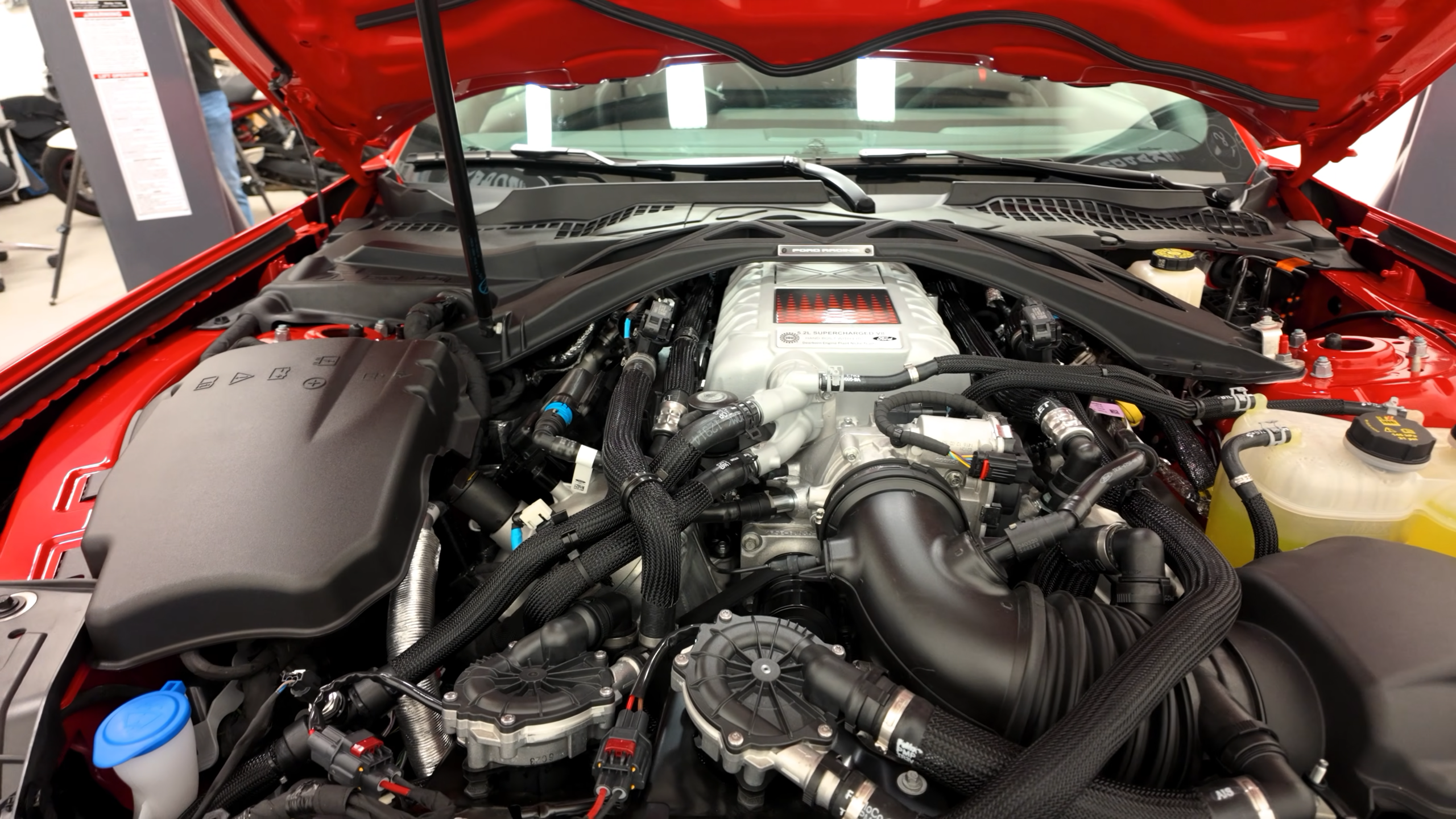
Ford describes the Dark Horse SC as its most powerful, advanced, and track-capable Dark Horse. Its broader purpose is also strategic. The Dark Horse name now connects Ford’s road cars with its racing programs, including the Mustang GT3, GT4, and Dark Horse R. The SC consequently serves as a higher-performance road-car bridge between the mainstream Mustang range and the GTD.
Cooling Became a Major Engineering Priority
Track driving exposes weaknesses that may never appear during normal road use. Sustained high engine speeds, braking, cornering, and acceleration continuously load the engine, transmission, differential, and braking systems. Ford therefore substantially increased airflow through the Dark Horse SC.
The central grille has approximately 60 percent more open area than the standard Dark Horse. Compared with the previous GT500, the SC’s central opening is more than 30 percent larger. The outboard cooler openings are also substantially larger, increasing their open area by more than 40 percent relative to the GT500.
The improvements extend beyond the front fascia. Ford engineers added a scoop for the transmission oil cooler, increasing airflow by roughly 10 percent. The engine receives a revised oil cooler, while the differential also benefits from additional cooling airflow.
These changes are particularly important because the SC remains a wet-sump engine rather than adopting the GTD’s dry-sump lubrication system. Ford’s reasoning is pragmatic. The company subjected the wet-sump configuration to extensive testing across multiple circuits and directly monitored oil quality and related parameters.
Engineers concluded that a dry-sump system was unnecessary for the SC’s intended operating envelope. That decision also avoids the additional cost, complexity, and weight associated with a dry-sump system.
Aerodynamics Without Losing the Mustang Shape
The SC’s aerodynamic development illustrates one of the more difficult compromises in the program.
Ford needed significantly more cooling airflow and downforce without turning the Mustang into something visually disconnected from its production identity. Engineers and designers therefore worked together throughout the development process rather than treating styling and aerodynamics as separate stages.
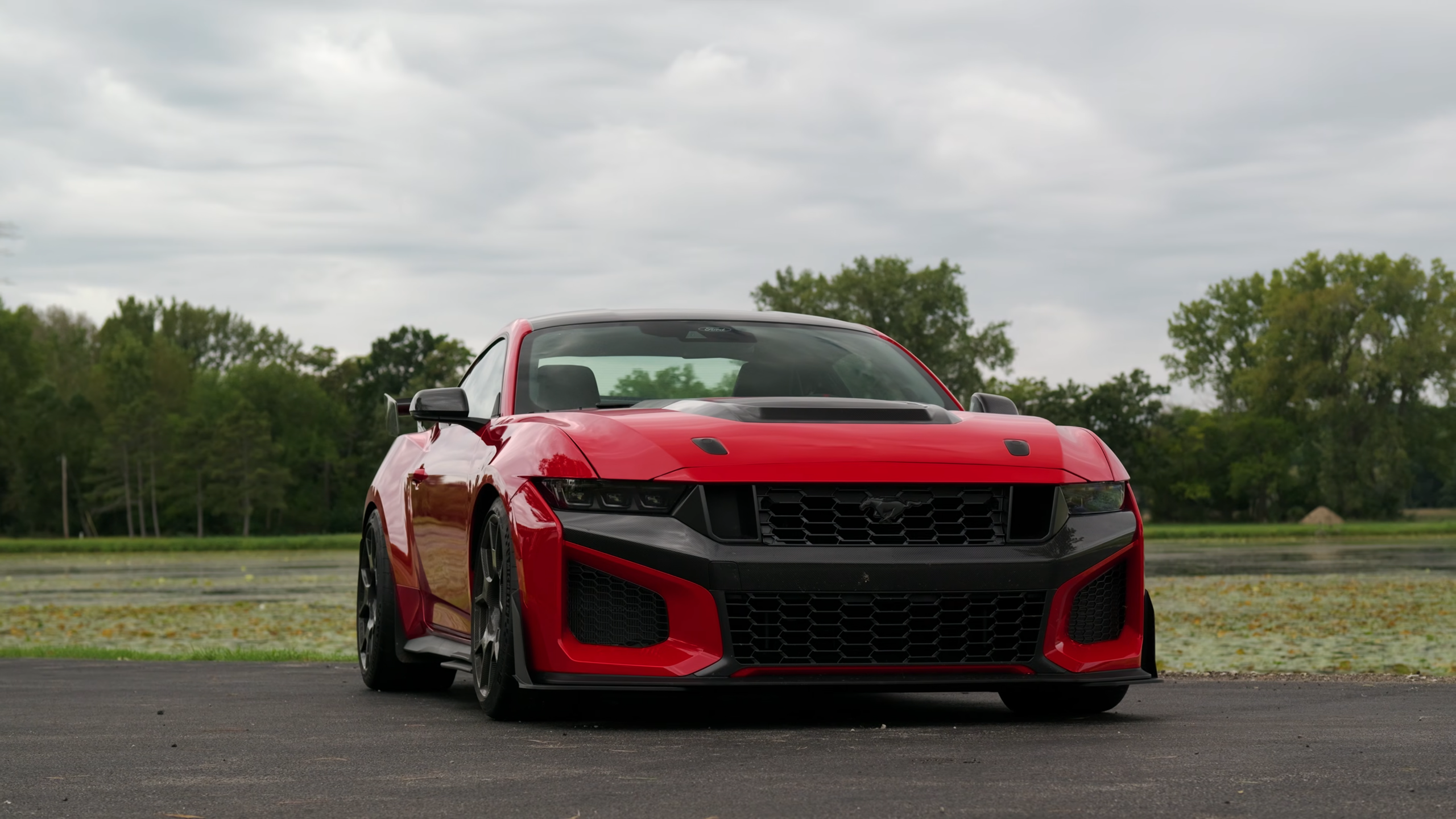
One of the most important additions is the rear decklid ducttail, which works with the carbon-fiber rear wing to increase aerodynamic load. Ford estimates that the combination produces approximately 10 to 12 percent more downforce than the wing alone. At 180 mph, that translates to roughly 620 pounds of downforce, around 70 pounds more than the GT500.
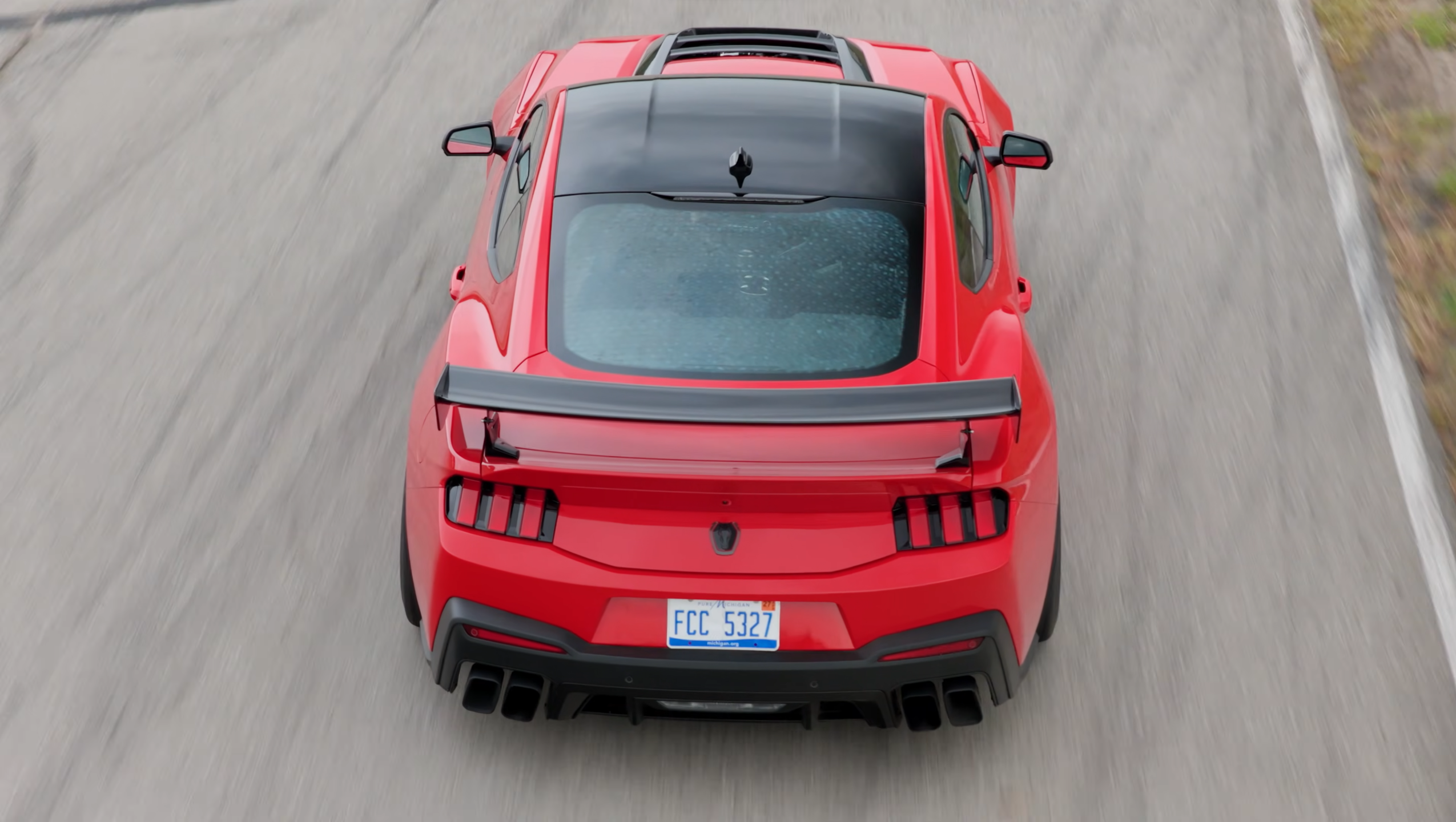
The front end also incorporates aerodynamic lessons derived from Ford’s racing programs. Revised brake ramps, additional splitter extensions, and other details reduce front-end lift and increase front aerodynamic load.
The development process itself borrowed heavily from NASCAR. Rather than repeatedly redesigning an entire front fascia for wind-tunnel testing, engineers used interchangeable 3D-printed sections. This allowed individual areas to be modified and tested rapidly.
The result was a much tighter development loop between computational analysis, physical prototypes, styling, and wind-tunnel testing.
Suspension Changes Give the SC Its Character
The Dark Horse SC still uses a MacPherson-strut front suspension and multi-link rear arrangement, so Ford was working within the fundamental limitations of the S650 platform. Instead of completely replacing that architecture, engineers concentrated on improving its behavior.
The front suspension receives aluminum lateral links, while the rear suspension gains an additional ball joint within the lower-link arrangement. The objective is improved camber control and better power delivery under acceleration. Ford also revised suspension geometry and roll centers to improve turn-in and traction.
The Track Pack version receives higher spring rates and stiffer anti-roll bars. The front bar measures 36 x 57 mm, while the rear uses a 25.4 x 4 mm configuration. The base SC uses slightly softer hardware.
The Track Pack also moves to wider 11.5-inch front wheels, compared with the 11-inch front wheels used previously on comparable Mustang performance configurations. These changes are subtle individually, but collectively they alter the character of the car. The SC is intended to respond more directly to steering inputs, remain flatter through corners, and transition more cleanly from one direction to another.
That becomes especially noticeable during rapid left-right transitions, where reduced body movement allows the tires to maintain a more consistent contact patch.
Tires, Wheels, and Brakes Transform the Track Pack
The difference between the two Dark Horse SC configurations is substantial. The base car remains a serious performance machine, using conventional wheels, iron brakes, fixed aerodynamic components, and a less aggressive suspension setup. It also retains a rear seat.
The Track Pack is effectively the dedicated circuit configuration. It combines carbon-fiber wheels, carbon-ceramic brakes derived from the GTD, and Michelin Pilot Sport Cup 2 R tires. The reduction in unsprung and rotational mass is significant, with Ford estimating approximately 150 pounds of savings compared with conventional components.
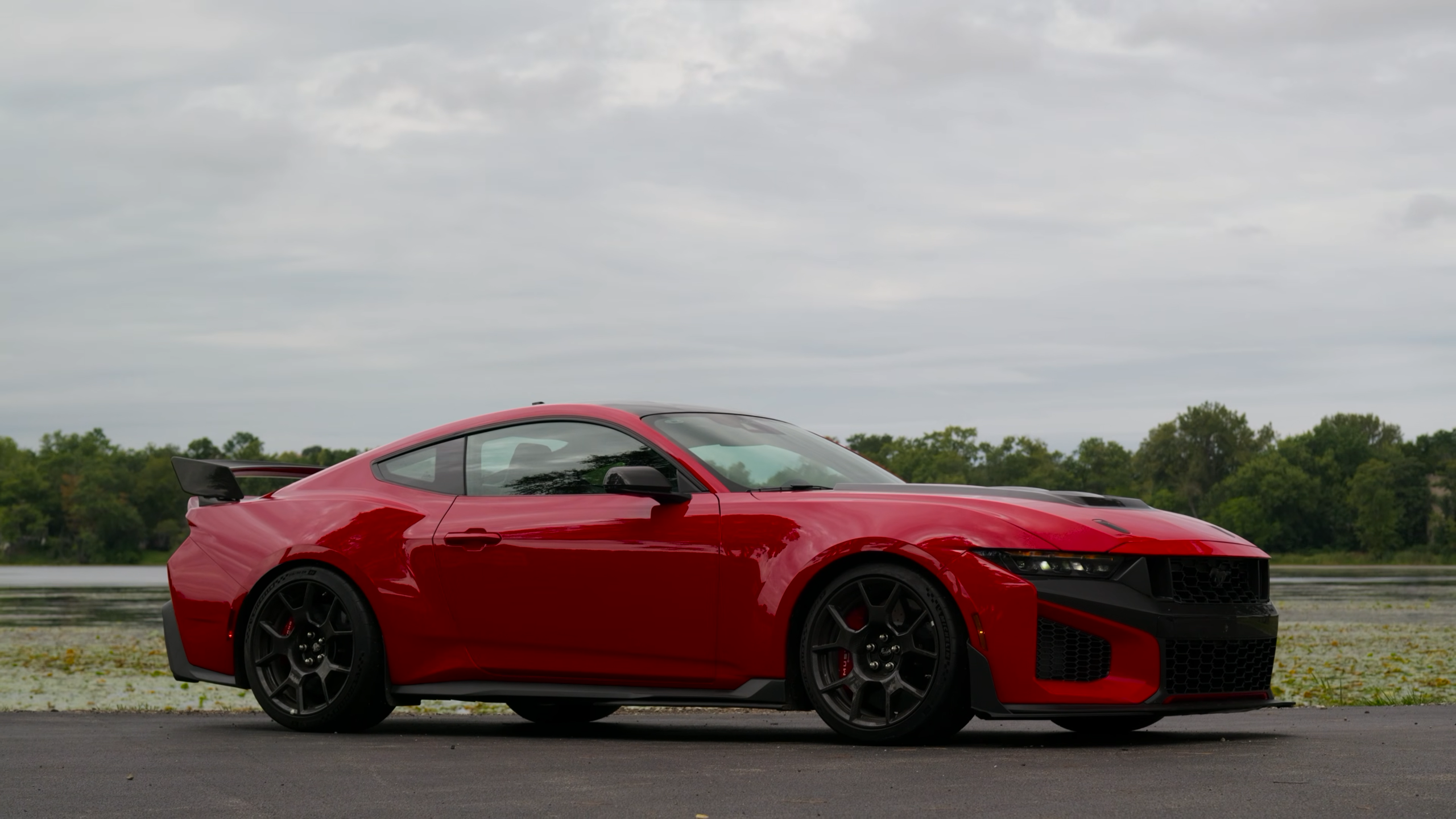
That reduction is important because unsprung mass affects more than acceleration. Lighter wheels allow the suspension to respond more effectively to bumps and surface changes while improving transient response. The Cup 2 R tires then provide substantially greater mechanical grip.
The combination of tire, wheel, brake, suspension, and aerodynamic upgrades gives the Track Pack considerably more cornering capability than the standard Dark Horse SC.
The Brake System Is One of the SC’s Biggest Achievements
Perhaps the most technically impressive aspect of the car is not its engine but its braking calibration. The SC uses Continental’s electronically controlled, decoupled braking system. Unlike the vacuum-assisted setup used in the previous-generation S550, the electronic system gives Ford considerably greater control over brake response and calibration.
On a high-performance track car, that matters because the brake pedal must remain consistent while the tires approach and exceed the ABS threshold. The engineers specifically targeted disturbance rejection—the ability of the system to maintain predictable brake behavior over bumps, curbs, and changing surface conditions.
The objective is not simply maximum stopping force. The driver needs to understand exactly what the front tires are doing while trail braking into a corner. Ford Racing engineers also tuned the system to preserve a predictable relationship between brake pressure, vehicle rotation, and tire grip as temperatures change.
That philosophy carries through the entire vehicle.
Predictability Over Raw Numbers
Ford’s vehicle-dynamics philosophy is particularly important because the Dark Horse SC has enough power to overwhelm inexperienced drivers. At nearly 800 horsepower, a car can easily become intimidating if throttle response, steering, braking, and chassis balance are poorly synchronized.
Ford instead deliberately tuned the SC to be approachable. The throttle contains greater resolution at low openings, allowing the driver to meter power more precisely when managing small amounts of rear-wheel slip. The chassis is designed to progressively approach the limit rather than suddenly transitioning from grip to instability.
If the front tires exceed their available grip, the response should remain progressive. The same principle applies to the rear axle. This gives the driver an opportunity to recognize what the car is doing and adjust accordingly.
That is a fundamental difference between a car designed merely to produce impressive test numbers and one designed as a genuine driver’s machine.
The Seven-Speed DCT Gets Smarter
The dual-clutch transmission also receives revised software. In Track mode, the driver can use the paddles to command shifts while allowing the transmission to perform certain upshifts automatically at the appropriate point. Ford added logic that recognizes when the driver is approaching redline under high-throttle conditions and can optimize the shift timing.
At the same time, the driver retains the ability to short-shift manually when managing wheelspin or optimizing corner exits. The result is a transmission that attempts to combine the speed of automated shifting with the control expected from a true performance-oriented manual mode.
How Fast Is It?
The Dark Horse SC demonstrated just how far Ford has pushed the S650 platform.
A Ford Racing engineer recorded a 1:27.58 lap at Autobahn Country Club South without tire warmers and without the extensive track preparation normally associated with professional performance testing. That figure puts the Mustang into serious company.
The comparison becomes even more interesting when considering substantially more expensive cars. Testing cited in the evaluation placed the SC within roughly a second of a current-generation Porsche 911 GT3 and Chevrolet Corvette Grand Sport under different test conditions.
The comparison is not perfectly equivalent because the competing cars were driven by professional drivers, had extensive track familiarity, and used tire warmers. Nevertheless, the data demonstrates the SC’s fundamental capability.
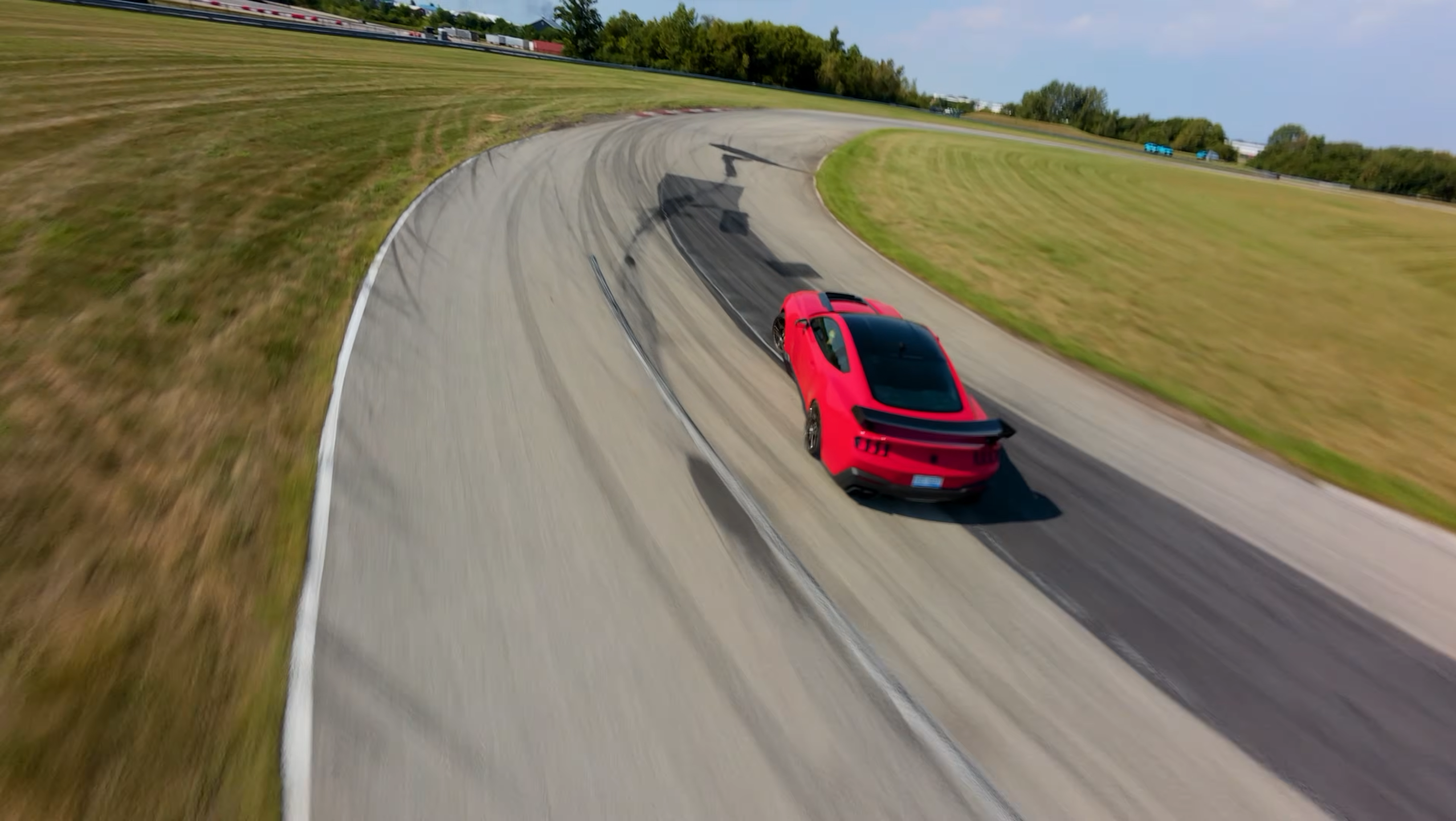
The Mustang was also significantly faster on the straights, with the SC reportedly carrying approximately 10 mph more speed than the Grand Sport and around 8–9 mph more than the GT3 on the back straight.
Its lap-time neighborhood includes cars such as the Porsche 911 GT3 and Corvette Z06/Z07, although the different test conditions make direct ranking inappropriate.
What is significant is not that the Mustang defeats those cars outright. It is that a production Mustang based on the S650 architecture can operate in the same performance conversation.
The Platform Is Still the Limitation
The SC’s greatest achievement may simultaneously expose the Mustang’s biggest weakness. Ford Racing has extracted extraordinary performance from the existing architecture, but the car still weighs more than 4,100 pounds in Track Pack specification. That mass affects braking, tire loading, and cornering performance.
The engineers have compensated with wider tires, carbon-fiber wheels, carbon-ceramic brakes, aerodynamic load, revised suspension geometry, and sophisticated electronic control systems. But physics remains physics. The front tires are being asked to perform several jobs simultaneously: braking, steering, and generating lateral grip while supporting a very heavy vehicle.
A future platform designed specifically around the requirements of a premium performance model could potentially unlock significantly more capability without relying on such extensive component upgrades. That is where the comparison with the GTD becomes particularly relevant.
Is the $100,000-Plus Price Justified?
The Dark Horse SC starts at roughly $108,000 including destination and gas-guzzler tax, while a heavily optioned Track Pack example can approach or exceed $150,000. That represents a dramatic increase over the previous GT500, which entered the market in a much lower price bracket.
The engineering makes the SC considerably more than a Dark Horse fitted with a supercharger. The powertrain is only one component of the transformation. The aerodynamic package, cooling system, suspension geometry, tires, brakes, wheels, electronic controls, and transmission calibration collectively create the car’s character.
But the price creates a different set of expectations. At $100,000-plus, buyers are no longer comparing the Mustang solely with other Mustangs. They are looking at Corvette Z06s, Porsche 911 variants, BMW M cars, Mercedes-AMG products, and other premium performance vehicles.
The Mustang’s interior and basic architecture remain recognizably connected to the much cheaper versions of the car. That makes the SC’s price difficult to justify from a luxury or material-quality perspective. Its justification comes almost entirely from driving performance.
Ford Racing Has Made the Mustang’s Bones Work
The Dark Horse SC is an unusual engineering exercise because Ford did not create an entirely new sports-car platform to achieve its objectives. Instead, Ford Racing took an architecture originally intended to support a broad Mustang lineup and progressively optimized it.
The SC demonstrates what happens when engineers are given the freedom to attack individual limitations systematically: cooling capacity increases, suspension geometry becomes more precise, aerodynamic load improves, brake calibration becomes more sophisticated, and the powertrain becomes easier to exploit.
The result is a Mustang that behaves fundamentally differently from the GT500 it replaces as Ford’s top conventional Mustang performance model.
The GT500 was brutally fast. The Dark Horse SC is more deliberate. It communicates more clearly, transitions more cleanly, brakes with greater consistency, and makes its enormous power easier to exploit. That distinction is ultimately what defines the car.
The Dark Horse SC is not the most rational Mustang in the lineup, nor is it the most affordable route to extreme performance. But as an exercise in extracting maximum capability from the S650 platform, it is remarkably successful.
Its greatest weakness is therefore also its greatest opportunity: Ford has demonstrated that the Mustang can compete at this level. The next question is what Ford Racing could accomplish if it were given a dedicated premium performance architecture rather than having to work within the compromises of the existing platform.
Source: savagegeese