
The Mustang RTR EcoBoost represents a deliberate shift in Ford’s performance strategy: instead of reserving serious chassis hardware and aggressive styling for V8-powered models, Ford and RTR have adapted key components from the Dark Horse and GT Performance Package to create a more attainable, track-focused four-cylinder Mustang. As Sam CarLegion’s review illustrates, the result is less a budget imitation of the Dark Horse than a lighter, more accessible interpretation of the same performance philosophy.
Ford Mustang RTR EcoBoost: Dark Horse Hardware Meets Four-Cylinder Performance
Ford’s decision to develop the RTR package around the EcoBoost Mustang is rooted in a simple market reality: not every enthusiast wants or can justify the cost and fuel consumption associated with a V8. The target customer is a younger buyer who wants the heritage, presence, and driving character of a Mustang without committing to a substantially more expensive performance car. The collaboration with RTR addresses that demand by combining the EcoBoost’s four-cylinder efficiency with hardware capable of supporting serious cornering and track use.
The formula is particularly interesting because the RTR does not rely solely on cosmetic upgrades. Ford incorporated heavy-duty sway bars and a rear subframe derived from the Dark Horse, while the GT Performance Package contributes Brembo braking hardware. The result is a chassis substantially more performance-oriented than the standard EcoBoost, giving the car the mechanical foundation to exploit its lower weight and turbocharged power delivery.
Aggressive Styling With a Functional Purpose
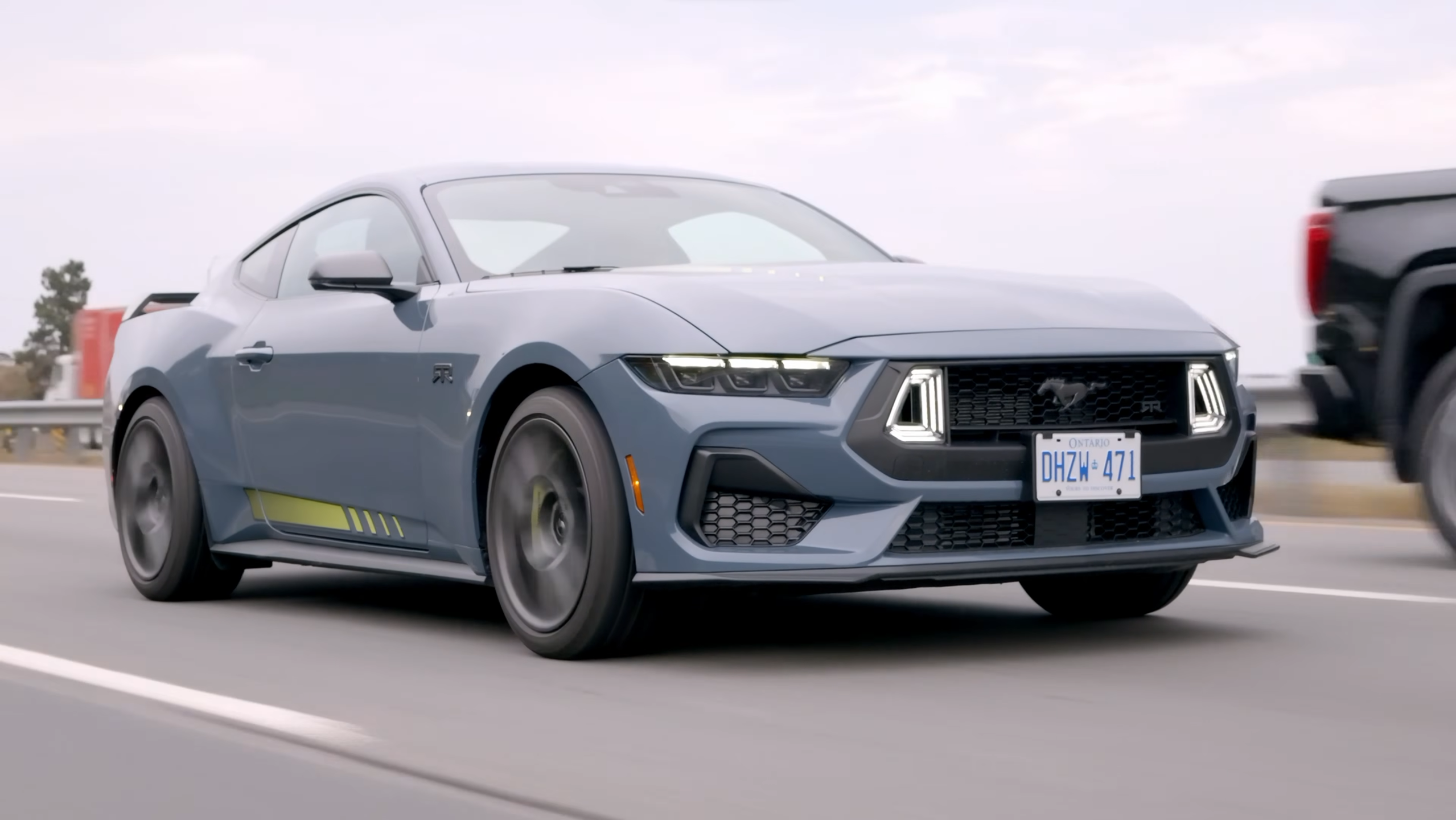
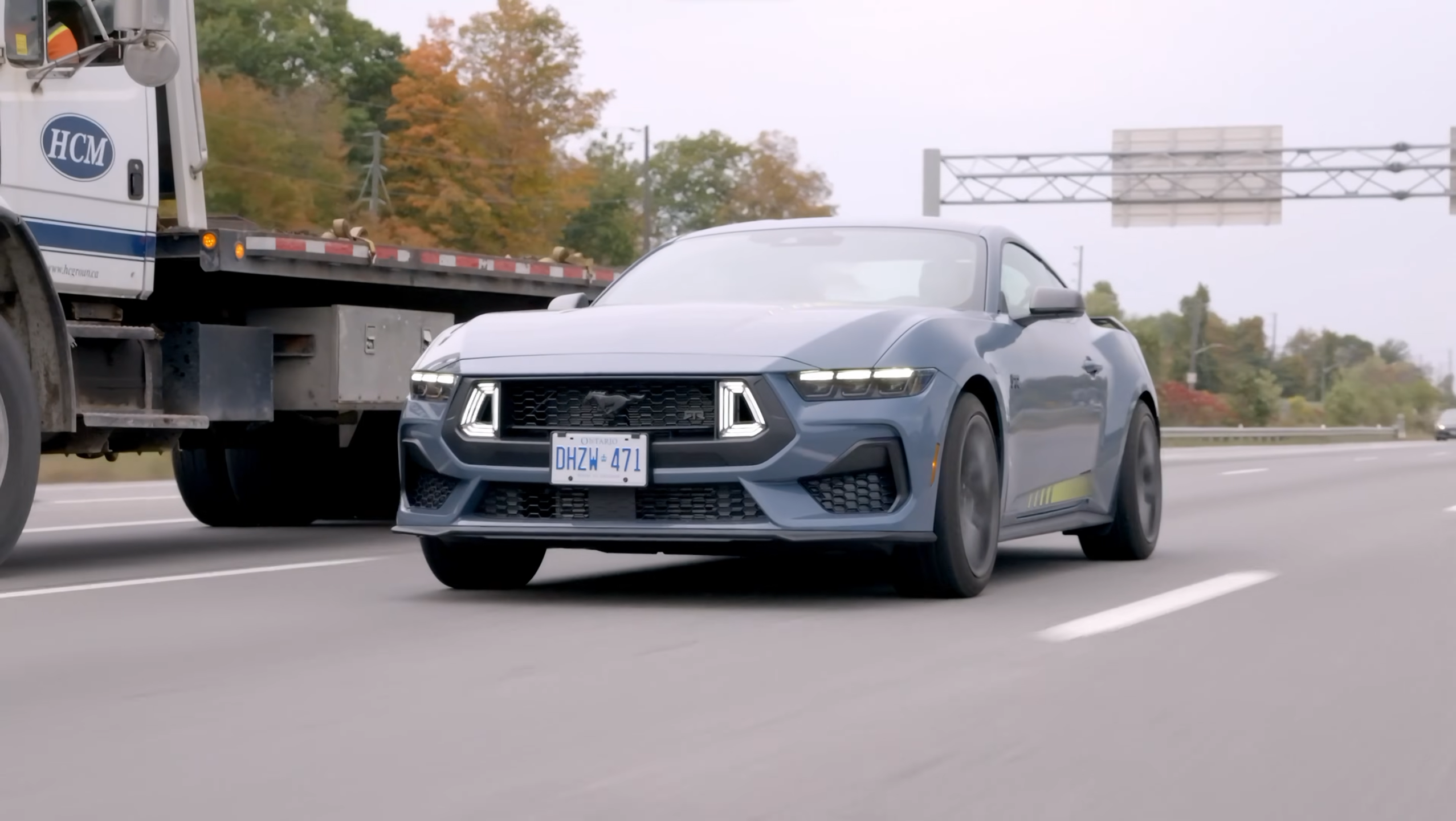
Visually, the RTR EcoBoost makes little attempt to hide its performance intentions. The front end receives an exclusive grille, RTR badging and the brand’s distinctive illuminated “nostril” elements. A performance front lip adds further visual aggression while contributing to the vehicle’s aerodynamic treatment.
The side profile is equally purposeful. The Mustang RTR rides on 19-inch wheels in a square configuration, with a 30-mm offset that pushes the wheels toward the outer edge of the fenders for a more muscular stance. Behind them are Brembo brakes, with the available Hyper Lime treatment adding one of the package’s most recognizable visual signatures. RTR badging on the fenders further distinguishes the car from an ordinary EcoBoost.
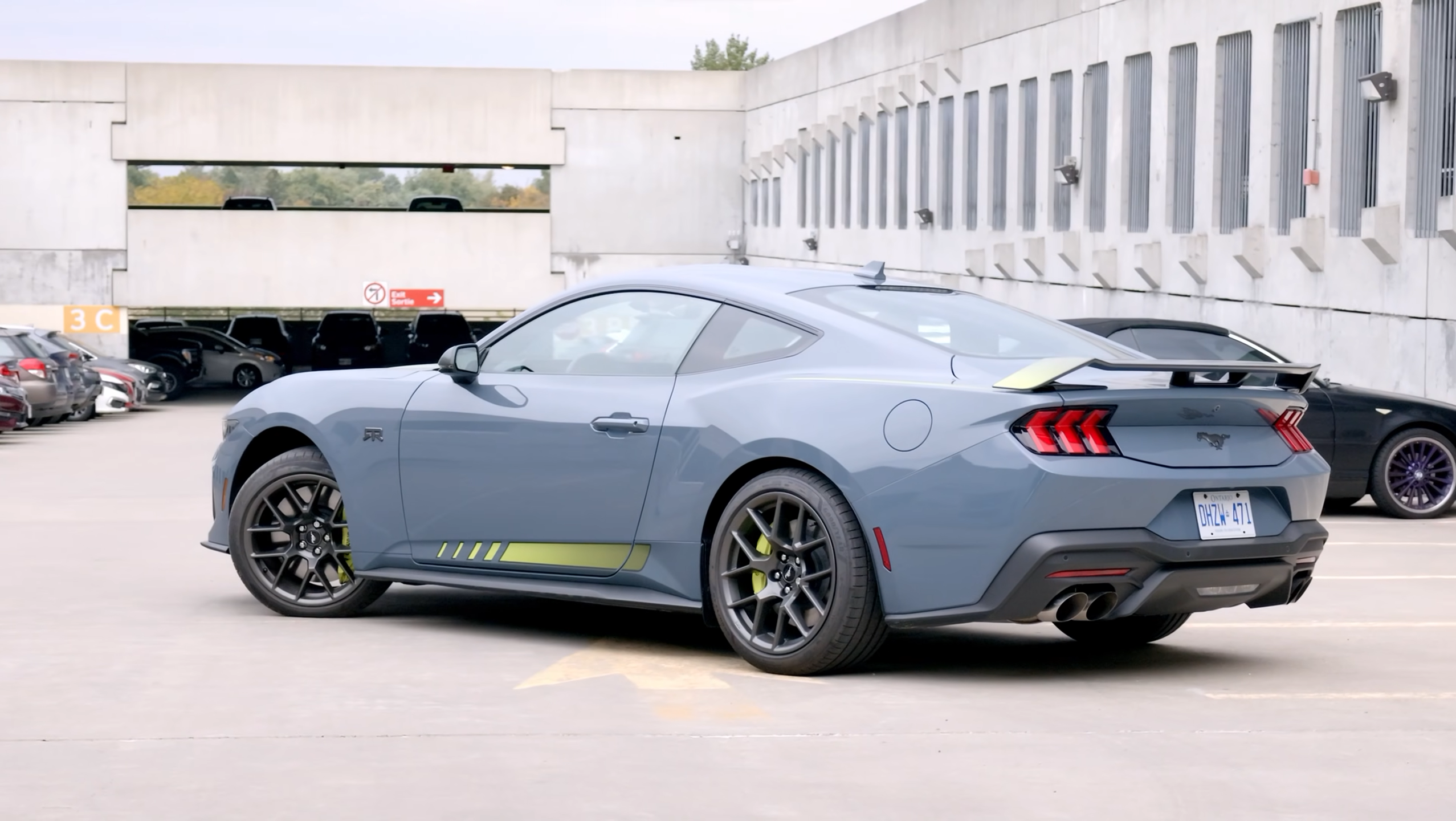
At the rear, the performance package contributes a spoiler, revised bumper treatment and quad exhaust outlets with valves that can be controlled through the Mustang’s driving modes. Although the EcoBoost lacks the V8 soundtrack of the GT and Dark Horse, the exhaust system gives the four-cylinder a more purposeful character while completing the RTR’s aggressive appearance.
A Highly Customizable Appearance Package
The RTR formula extends beyond hardware. Ford offers an extensive visual transformation involving graphics, contrasting accents and Hyper Lime detailing. The full RTR package discussed in the review costs approximately $9,750 Canadian and combines the appearance changes with anti-lag tuning, Dark Horse-derived suspension components, GT Performance Brembo brakes and a drift brake. An appearance-only tire package is also available separately.
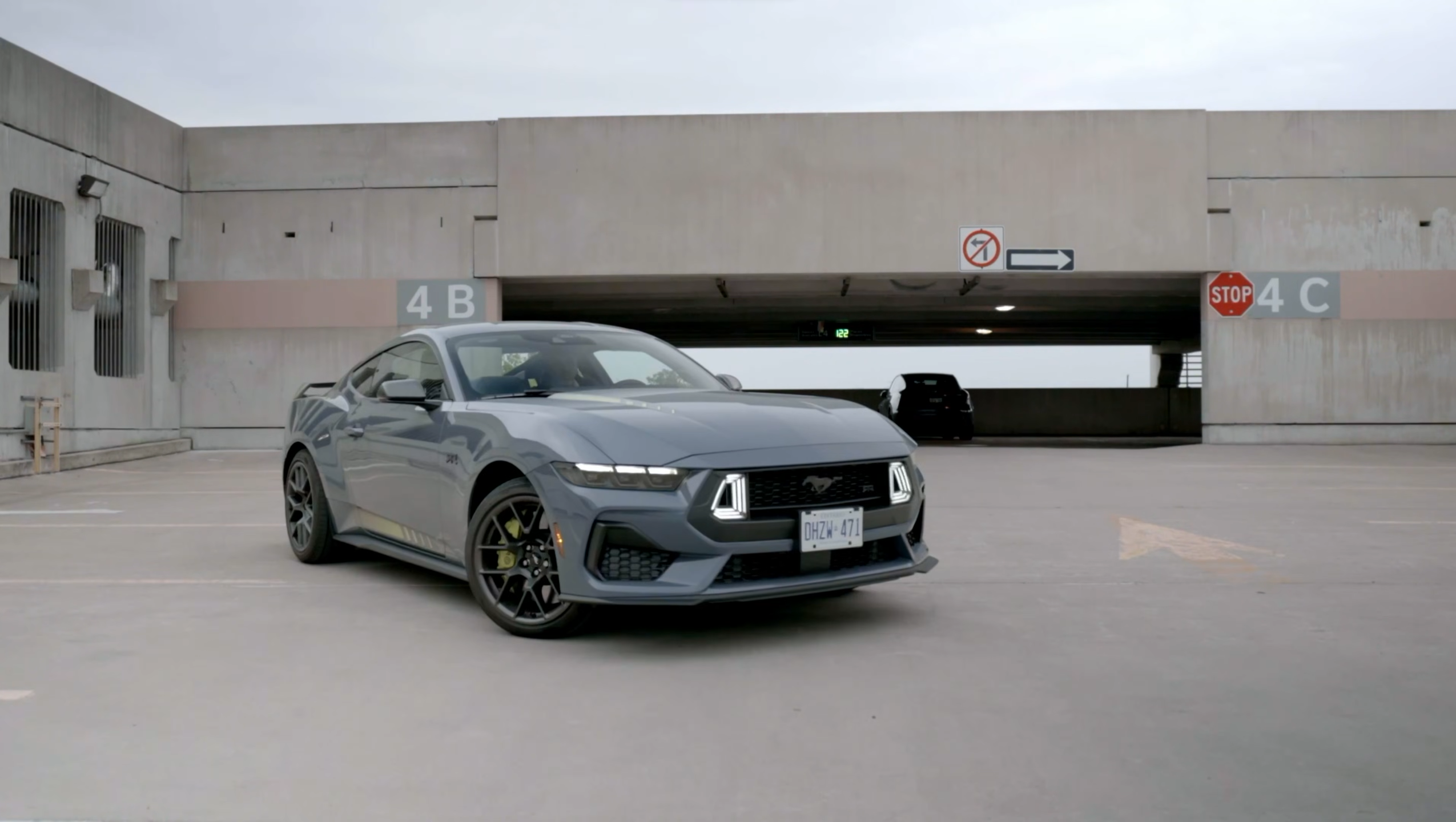
However, the customization strategy comes with limitations. Certain paint colors and factory options cannot be combined with the RTR package. Selecting colors such as Race Red or Molten Magenta Metallic Tri-coat can force the package to be removed, while the factory-painted black roof triggers a switch to the Night Pony package. Ford has therefore structured the RTR as a tightly integrated factory configuration rather than a collection of completely independent options.
Interior: Performance Technology With RTR Character
Inside, the RTR treatment is considerably more subtle than the exterior. Mustang RTR door-sill plates introduce the package, while Hyper Lime accents appear throughout the cabin. The color is carried through the seat belts, stitching, dashboard, door panels, center console and steering wheel, creating a consistent visual theme rather than limiting the customization to a few isolated details.
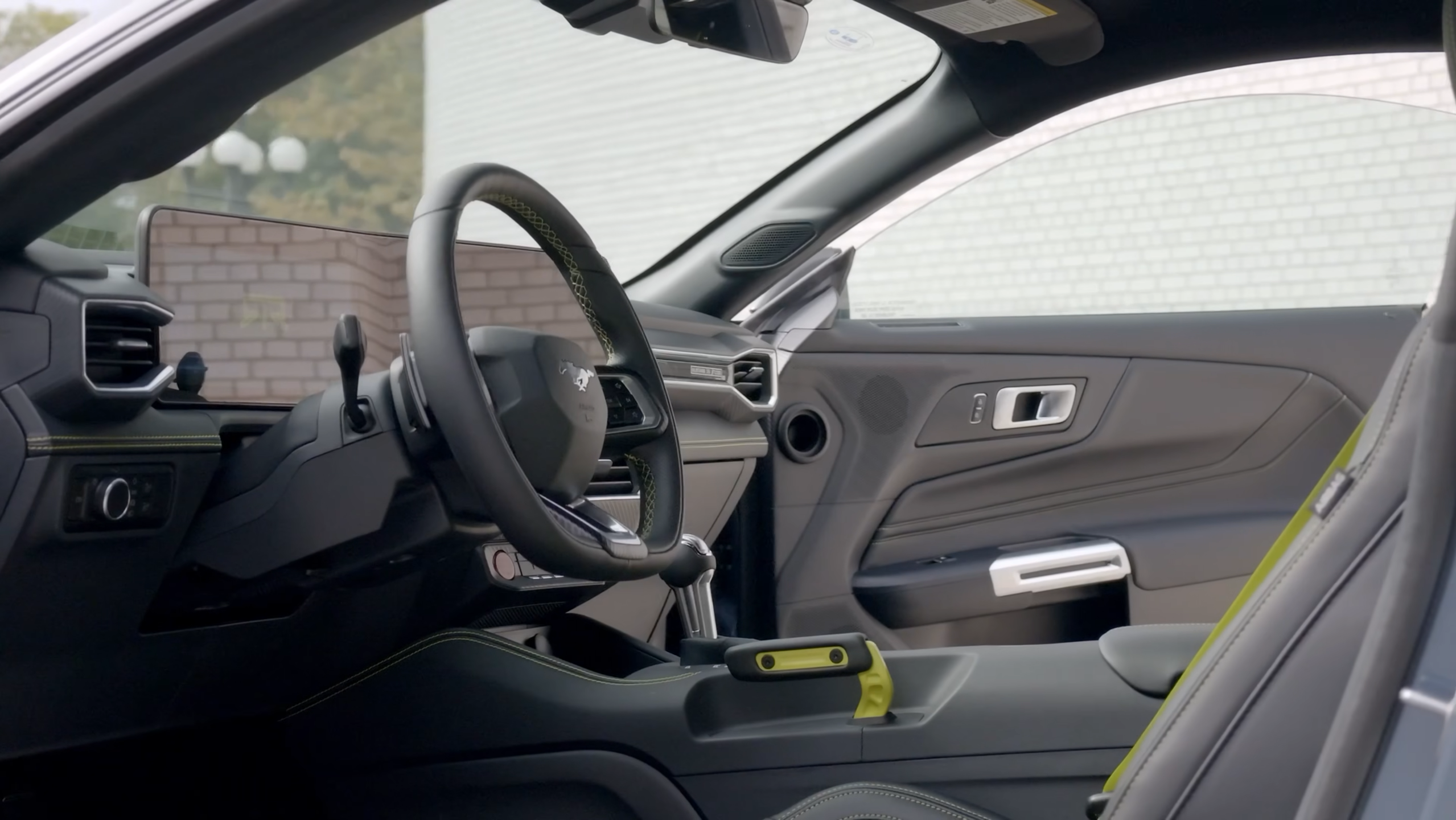
The cabin remains oriented toward everyday usability, however. The review notes that the standard seats are more daily-driver focused rather than dedicated performance seats, with Recaro units absent from the package. That distinction reinforces the RTR’s position as a dual-purpose Mustang: aggressive enough for track and drift use, but still practical enough to serve as everyday transportation.
Technology is also part of the package. The Mustang’s curved display receives a dedicated RTR startup and shutdown interface, giving the cabin a more distinctive identity. Heated seats, a heated steering wheel, multiple driving modes and the ability to manually control the automatic transmission are retained, while the Hyper Lime package adds the distinctive drift handbrake. A Bang & Olufsen audio system is also included, although wireless phone charging is not.
The Mechanical Difference: More Than an Appearance Package
The most important aspect of the RTR EcoBoost is what lies beneath the bodywork. Unlike a conventional appearance package, this Mustang receives genuine performance modifications. The combination of Dark Horse suspension components, heavy-duty sway bars, a Dark Horse-derived rear subframe and Brembo brakes gives the EcoBoost a chassis designed to withstand considerably more aggressive driving.
Power is delivered exclusively through a 10-speed automatic transmission in the configuration reviewed. That choice reflects Ford’s effort to make the car accessible to buyers who may prioritize ease of use over the involvement of a manual transmission. The automatic also works with the Mustang’s selectable driving modes, including Track and Drift modes.
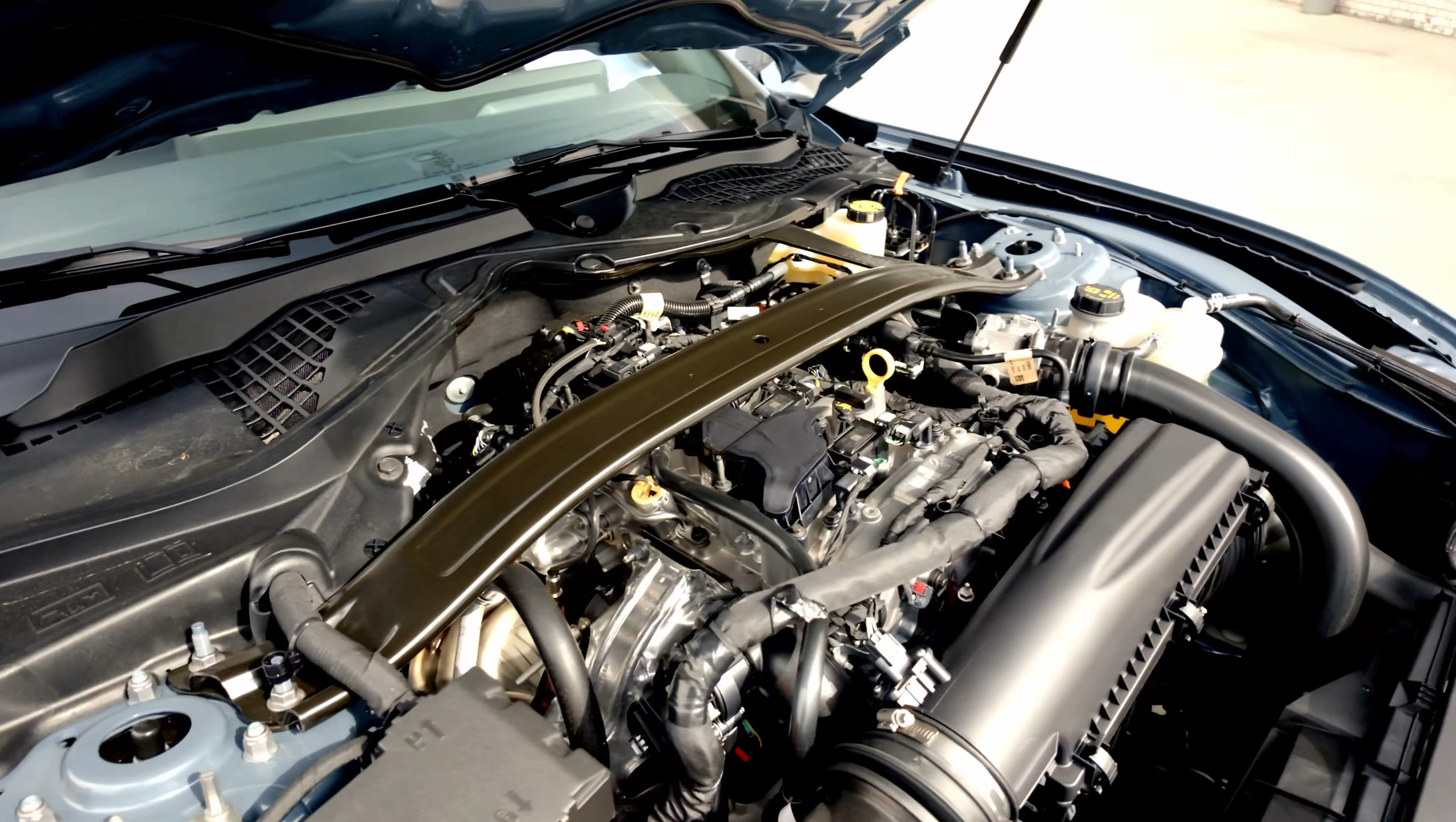
The four-cylinder’s biggest advantage is not outright power but weight. Compared with the V8-powered Dark Horse, the EcoBoost carries significantly less mass over the front axle. According to the review, that difference is immediately noticeable, with the RTR feeling particularly planted through corners. Rather than attempting to reproduce the Dark Horse’s straight-line performance, Ford and RTR have created a car that emphasizes agility and balance.
Anti-Lag Adds Another Dimension
One of the package’s most significant technical features is its anti-lag system. The review identifies the technology as having been adapted from Ford’s motorsport experience, with the system becoming particularly noticeable in Track mode. By keeping the turbocharger responsive, anti-lag reduces the sensation of waiting for boost and gives the 2.3-liter engine a sharper response when the throttle is opened.
That responsiveness is central to the RTR’s character. The EcoBoost does not attempt to imitate the sound or brute-force acceleration of the 5.0-liter V8. Instead, its appeal comes from combining turbocharged torque, lower weight, chassis upgrades and quicker response into a package that can be exploited more readily on a winding road or circuit.
The review also points out the engine’s tuning potential. With additional Ford Performance tuning, the 2.3-liter can move toward the 350-horsepower and 400-lb-ft range cited in the review, demonstrating that the EcoBoost platform has considerably more performance headroom than its reputation sometimes suggests.
A Different Kind of Mustang Performance
The Mustang RTR EcoBoost is ultimately significant because it challenges the assumption that performance Mustangs must revolve around a V8. The Dark Horse remains the more powerful and fundamentally more serious performance model, but the RTR demonstrates how Ford can transfer selected high-performance components into a less expensive, lighter and more economical package.
That distinction is important. The RTR is not designed to replace the Dark Horse. It targets a different enthusiast—one who wants the Mustang’s visual presence, heritage and driving excitement without paying the financial and fuel penalties associated with a V8-powered model. The review specifically frames the car around buyers who want something affordable enough to drive every day while still offering genuine performance capability.
At approximately $57,000 Canadian in the configuration discussed, the RTR EcoBoost occupies an interesting position in the sports-car market. It combines Mustang practicality and cabin space with aggressive styling, substantial chassis upgrades, Brembo braking hardware, anti-lag technology and drift-oriented functionality.
The result is a Mustang that makes a compelling argument for the four-cylinder formula. It may not deliver the visceral soundtrack of the Coyote V8, but it does not need to. By borrowing intelligently from the Dark Horse rather than attempting to replicate it wholesale, Ford and RTR have created a lighter, more accessible and technically credible performance Mustang—one that is designed to be driven hard rather than simply look fast.
Source: Sam CarLegion