

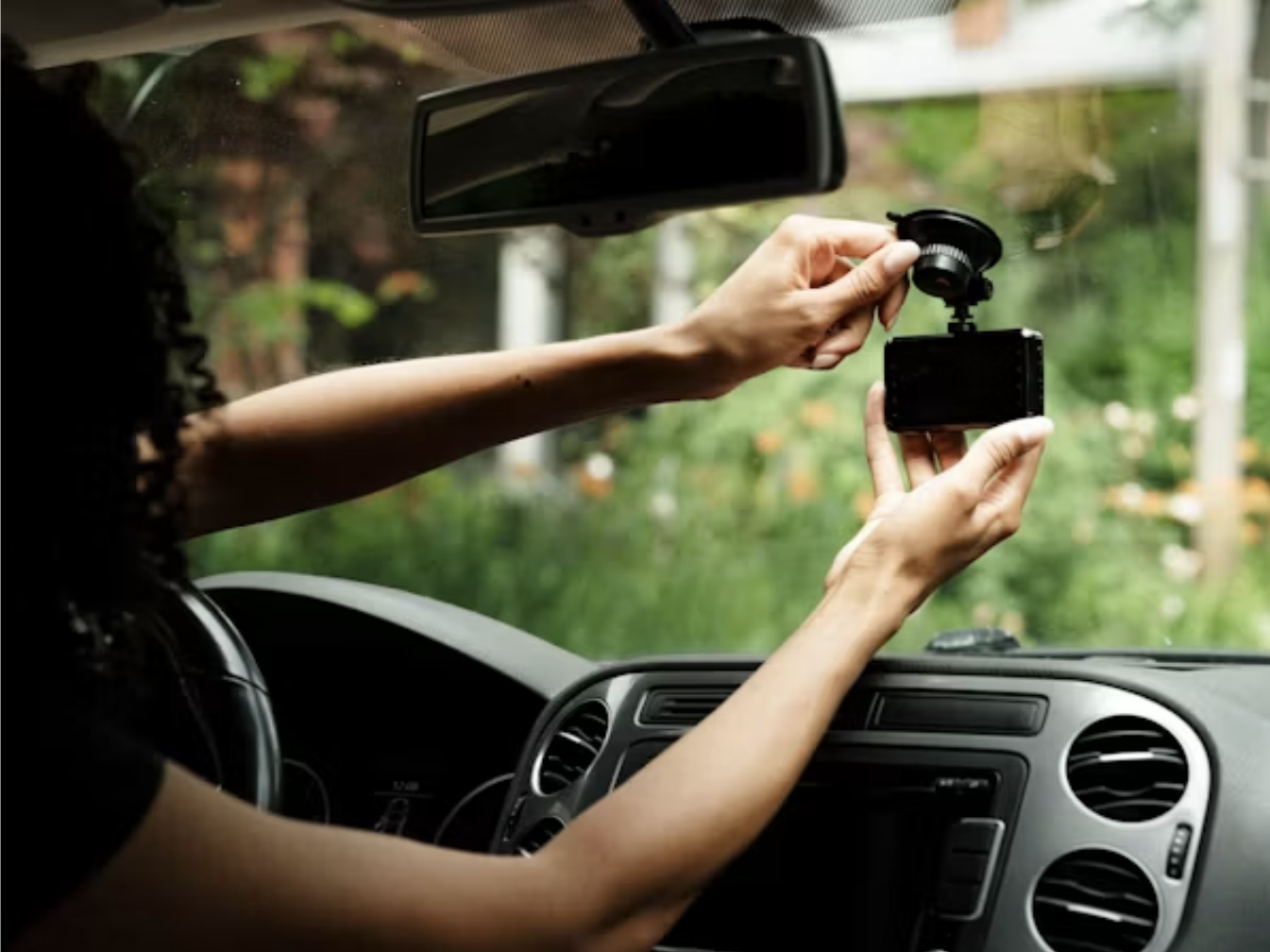
Most people buy their first dash cam after something goes wrong, a fender bender they don’t cause, a scratch on the parking lot that seemed to come out of nowhere, or a road rage incident where it came down to their word versus the word of someone else. In many of these cases, the driver had a dash cam, but was only recording forward, and the footage that would have settled the argument was happening behind.
It’s a gap that catches people off-guard, and a front-facing camera only records head on collisions, near-misses, and reckless drivers cutting in on the side; nothing behind, including being backed into by a driver at a red light, hit-and-run in a parking garage, or delivery truck backing into a bumper while the driver is inside the store. A camera facing only the front of the car accounts only for part of a driver’s exposure, and it doesn’t become apparent to many drivers until it’s too late to do anything about it.
Why the Assumption “One Camera Is Enough” Doesn’t Hold Up
There’s an assumption that most of the accidents that happen fall in front of the car, rather than from behind, and that a front-facing camera covers most of what could have gone wrong
This isn’t necessarily false, but only in a theoretical sense. An accident doesn’t need to happen constantly to be costly, just often enough to happen once at the wrong time with no footage to prove it, and a fair share of everyday incidents happen in places a front camera is blind to: in cities or inside parking structures. There’s another, practical difference between having footage and having footage that settles a dispute in a driver’s favor. A front camera, aimed at the road, doesn’t record if a car in the next lane reverses into the side of their car, or if they are rear-ended at a red light. In both cases, a recording, any recording, tends to speed the process of dealing with insurance, and shift the power of proving a dispute in favor of the camera’s owner, since adjusters have admitted they weigh video evidence more heavily than either side’s word for what happened, since it removes the guesswork.
What Rear Coverage Actually Changes
A dash cam is assumed to be a dash cam, regardless of how many cameras it has. What rear coverage changes is how insurance claims and disputes get resolved, because adjusters and police work from what’s on the recording. With only front footage and a dispute about something happening from behind, the case reverts to witnesses. Witnesses move on, and memories of details get fuzzy, and in a lot of minor incidents there simply isn’t one to begin with.
Parking lot incidents are a separate argument, that front cameras are poorly equipped to handle. A lot of parking dings and side swipes happen while a car is stopped, and a front camera has a field of view that covers neither. A rear channel, with parking mode and motion detection, is what captures that type of incident. It matters more than it might appear, since a large share of dash cam footage that gets used in a claim comes from parking-related incidents, rather than moving accidents.
There’s a secondary benefit that isn’t discussed as often: rear footage can also protect a driver from false claims. If someone reverses into a parked car and later claims the other driver was at fault, rear footage from a stationary vehicle can settle the matter almost immediately, without back-and-forth. It works both ways: a driver with rear coverage is protected both when they’re the victim of an incident, and when they’re wrongly accused of causing one.
How This Plays Out for Different Types of Drivers
The value of rear coverage isn’t the same for everyone, and it’s worth thinking about in terms of actual driving patterns, rather than as a blanket recommendation.
For someone who mainly drives short, familiar trips and parks in a private driveway, exposure to rear-facing risk is lower (though not zero) – driveway backing incidents involving other family vehicles or delivery trucks are still fairly common. For drivers who commute in dense traffic, park in shared garages, or drive for work (including rideshare, delivery, or fleet drivers) the exposure is considerably higher, since they’re spending more time stopped in traffic, parking structures, and around vehicles they don’t control. Fleet and rideshare drivers in particular tend to be required by the platforms they work for, or their insurers, to hold dual-channel footage, since disputes involving passengers or other vehicles are more frequent in that type of driving.
There’s another category of drivers who park on the street overnight, where the parking mode and rear camera combination does most of it’s work while the car isn’t even being driven. For this group, the camera’s behavior while parked is often the more relevant consideration.
What to Look for When Choosing a Front and Rear Dash Cam
Two-camera systems vary a lot between models, and it’s not always obvious from a product listing. Front camera resolution tends to get the lion’s share of the attention in marketing copy, but the rear camera is frequently lower-resolution as a result, sometimes down to 720p, which isn’t enough to read a plate number outside of good daytime conditions.
A few specifications are worth looking at before purchase:
The resolution balance between the two cameras matters more than the headline number on the front camera alone. A 4K front paired with a 1080P rear is a common configuration that keeps resolution reasonable on both ends, without overly-large file sizes that fill up a memory card within a day or two of driving. A wide-angle field of view on both lenses reduces blind spots, though angles over roughly 170° start to distort edges on the image, which can make it harder to read plates or signage near the border of the field of view.Night performance is another aspect that’s easy to overlook until it becomes a practical concern. Many accidents and parking lot incidents happen after dark, and camera sensors vary widely in their ability to handle low-light conditions. A camera that performs well in daylight tests can capture a blurry, noisy night, particularly on the rear channel, which tends to have a smaller sensor than the front.
Parking mode is implemented differently on various models: recording only on impact, or recording with motion detection added, or combining motion detection with low-power mode to avoid draining a battery overnight. Whether parking mode requires a separate hardwire kit is worth confirming before purchase, since some listings don’t make this clear upfront, and the kit is often sold separately.
Wi-Fi transfer speed affects how quickly a clip can be sent off the camera with a phone app. This ranges widely between models, from around 2MB/s on older units to considerably faster speeds on newer ones. This becomes a concern primarily in situations where footage needs to be sent on to an insurer or authority quickly.Storage and loop recording behavior are worth understanding. Loop recording means the camera continually overwrites the oldest footage once storage is full. This keeps the camera running indefinitely, on the downside it means unprotected footage can be lost if it isn’t saved in time. Cameras with G-sensor detection automatically lock and protect footage from a detected impact, keeping that specific clip from being overwritten during the loop cycle.
One example of a front and rear dash cam in this category is the REDTIGER F77. Its biggest advantage is true 4K recording from both the front and rear cameras, with each camera using a Sony STARVIS 2 IMX678 sensor and recording at 3840×2160. HDR on both channels helps preserve detail in bright and low-light conditions, while the dual STARVIS 2 sensors improve image clarity in challenging nighttime scenes. The F77 also features a 4-inch IPS touchscreen, voice control, built-in 128GB or 256GB eMMC storage, and 5.8GHz Wi-Fi for fast video transfers to the REDTIGER app. The included hardwire kit enables parking monitoring, with G-sensor and time-lapse recording options. Built-in GPS records driving information such as speed, route, and location, while the rear camera is designed for interior installation because it is not waterproof. The F77 supports temperatures from −4°F to 158°F and comes with an 18-month standard warranty plus an additional 6-month warranty when purchased through the official REDTIGER website.
Common Misconceptions About Dual-Channel Dash Cams
A few assumptions tend to come up among drivers who haven’t used a two-camera system before, and most of them don’t hold up under further scrutiny.
One is that a rear camera is redundant if the car already has a factory backup camera. Backup cameras are designed to assist with reversing over short distances, and generally don’t record or save footage. They provide a live feed, and nothing more. A dash cam’s rear channel, on the other hand, continually records and stores footage.Another assumption is that dual-channel systems are significantly harder to install or maintain than single-camera units. The main additional step is running one cable to the rear of the vehicle, which is a manageable task in most cars. Day-to-day operation – reviewing footage, formatting the memory card, adjusting settings – is generally identical between single and dual-camera systems.There’s also a belief that more cameras means faster storage turnover and more hassle managing footage. While dual-channel recording does use more storage than a single-camera setup, larger and more affordable memory cards have largely offset this, and loop recording takes care of the overwriting automatically, without needing to manage it.
Installation Is Simpler Than People Expect
One reason people avoid two-camera systems is the assumption that running a wire to the back of the car is a large and involved job. In most vehicles, it’s not. The cable is usually run along the headlining, and down a door pillar, hidden under existing trim, and the process takes around twenty minutes, rather than an hour. Some vehicles with more complex interior paneling will take longer, including SUVs and vans with additional trim panels near the rear window, but it’s a manageable task with some trim removal tools. For drivers who prefer not to do this themselves, most installation shops can mount a rear camera in under thirty minutes. And it is a one-time job, rather than something that needs to be done or maintained regularly.
The main ongoing task after installation is periodically checking that the rear lens is clean. Rear windows tend to collect more dust and grime than windshields, particularly on vehicles with rear wipers that aren’t used often.
Legal and Insurance Considerations Worth Knowing
Dash cam footage, including rear-facing footage, is generally admissible as evidence in most jurisdictions, though rules vary by region regarding audio recording consent, since some areas treat continuous audio recording differently from video. It’s worth checking local regulations if audio recording is a concern, since some dash cams allow audio to be disabled independently of video.
Some insurers offer modest discounts for vehicles equipped with dash cams, particularly dual-channel systems, on the reasoning that footage reduces disputed claims and fraud. This isn’t universal, and the specifics vary by insurer and region, but it’s worth asking about when comparing policies, since it can offset part of the cost of the equipment over time.
Cost Considerations
The cost difference between front-only and front and rear dash cam setups is often smaller than expected . Buyers sometimes treat the rear camera as an optional add-on, but the incremental cost is usually modest relative to the cost of dealing with an undocumented accident or parking dispute. Additional costs to factor in include a hardwire kit if parking mode is desired, and a memory card if one isn’t included. Higher-resolution dual-channel recording tends to require larger storage than single-camera setups.
Making the Decision
For occasional drivers mainly concerned with documenting their own mistakes on the road, a front-only camera may be sufficient. For drivers who park in shared spaces, drive for work, or have been in disputes over fault, rear coverage becomes a more relevant factor to weigh. The cost difference between front-only and front-and-rear setups is often smaller than expected, though whether it’s worthwhile depends heavily on how and where the vehicle is used and how much value is placed on having a complete record, rather than a partial one.
The relevant comparison between models tends to be not the length of the feature list on the outside, but which camera continues to work reliably, transfer footage without issue, and captures what’s needed when something actually happens. That is the standard most directly tied to whether a dash cam serves its purpose, independent of brand or price point.