

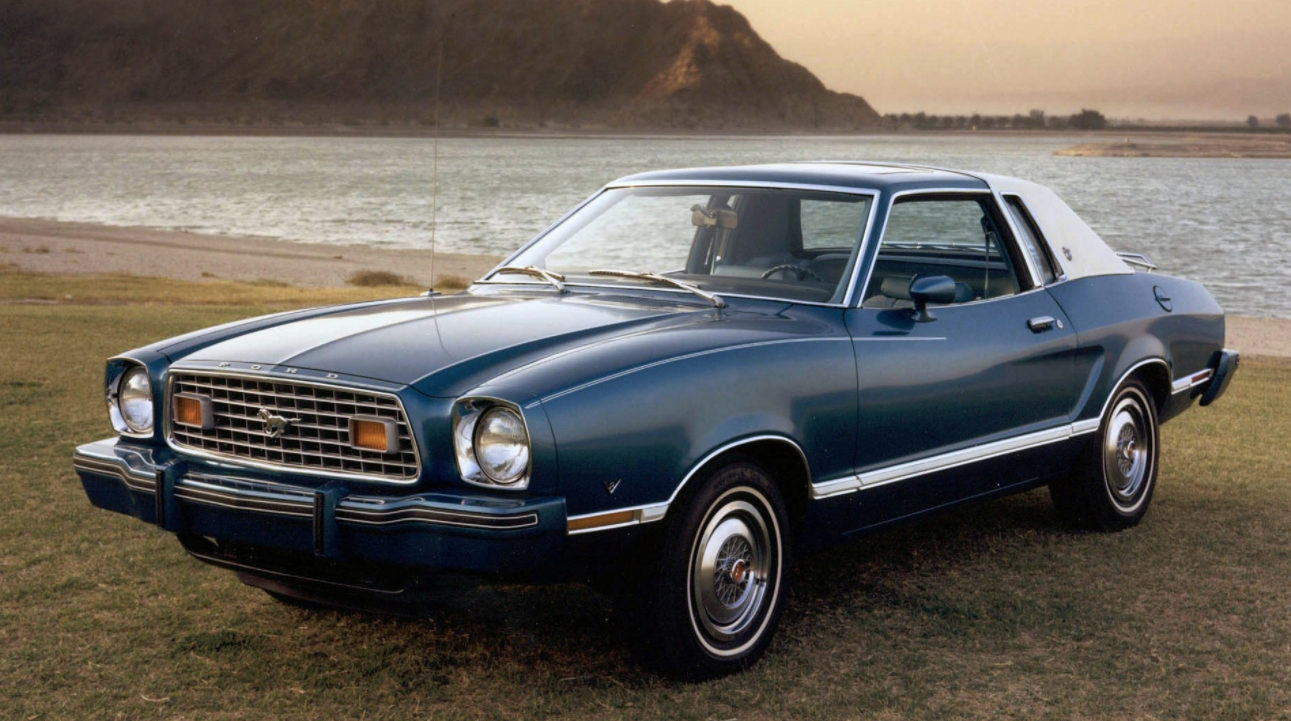

1974 Ford Mustang
1974 Ford Mustang II Overview
The 1974 Mustang marked the beginning of the “Mustang II” generation. These smaller cars had weaker engines due to the fuel crisis, and proved to be a hit with buyers. Even with slower cars and higher prices, sales nearly tripled the 1973 numbers, and the Mustang II was named Motor Trend’s Car of the Year. Mustang IIs featured rack-and-pinion steering, which made driving easier and more comfortable. The switch to rack-and-pinion became a popular modification for first-generation owners.
| Model: | 1974 Ford Mustang |
| Generation: | 2nd Generation Mustang |
| Type: | 2 Door |
| Body Styles: | Coupe, Fastback |
| Engines: | 140ci 2V 4 cyl, 171ci 2V V6 |
| Original Price: | $3,134 (Basic Coupe), $3,328 (Fastback) |
| Units Produced: | 385,993 |
Additional 1974 Mustang Research: 1974 Research Center / Colors Details / Production Numbers / Prices & Options / Sales Brochures / Owner Manuals / Maintenance / Pictures / Videos / VIN Decoder / Special Editions
Background & Details
By 1973, the Mustang had grown away from its original dimensions. Small, sporty, economical import cars were becoming more and more popular with their luxurious interiors, thrifty engines, and manual transmissions. At Ford, Lee Iacocca wanted to bring the Mustang back to a small, sporty, luxurious, personal car that would compete well against these imports. The result was a Mustang that was smaller and more luxurious than ever before. This was the beginning of the second generation Mustangs. Welcome to the world, the Mustang II.
The story of how the Mustang II came to be is quite interesting. They had many obstacles to overcome and a very short time frame to accomplish the task. In fact it was almost canceled as a project because they could not get the car to ride like a good car should. It rode like a Pinto and that was just not acceptable. I owned a Pinto in 1974, and would have been pissed if I had a Mustang that rode like that. But they fixed the ride by using the subframe isolator that looked like a toilet seat, hence the unofficial name Toilet Seat. Then Ford put more sound deadener in it than they used in Lincoln.
Although it vaguely resembled a Mustang, (about as much a Camaro did) it still had the Mustang nameplate. In fact the only thing that really looked like a Mustang was the indented side sculpturing. This is not to say that it wasn’t better in many ways, just that it was radically different in so many ways. You could buy either a hardtop or a 3-door hatchback. Additionally the hardtop was offered as a Ghia or luxury style and the hatchback was offered as a Mach 1 or sporty looking (but not performing) option.
The previous generations had grown up, and grown and grown. In fact even though the reason for the increase in the Mustang’s size was to accommodate a larger engine, the vehicle under performed and was less responsive every year. The first Mustangs were small and nimble but as they grew, the ride became better, smoother and larger engines were needed to pull the load, thus the bloat factor. The ’74 Mustang was a trip back in time to the smaller Mustang. The Mustang II was 13 inches shorter in wheelbase than the 1973 model year, 19 inches shorter overall, 4 inches narrower, and 450 pounds lighter too. Compared to the 1965 Mustang, the II was 11.8″ shorter in wheelbase, 6.6″ shorter in length, and 2″ narrower.
A Little More Luxury
The Mustang II was more plush inside with its low-back, non-reclining bucket seats in different grades of cloth or vinyl, and simulated woodgrain trim on the instrument panel, optional door panels, gear-shift lever, and parking brake lever. The colors were more pastel to the effect of an elegant car rather than a performance sports car. Standard gauges included a tachometer, temperature gauge, and ammeter, with brake, oil, and “Fasten Belts” warning lights. The interior was quieter (probably because there was no engine roar).
Mustang II offered 4 models to choose from: a 2-door coupe, a 3-door hatchback, the Ghia 2-door coupe, which replaced the Grande as the luxury model and featured a standard full-vinyl roof, and the 3-door Mach 1, which featured black lower-bodyside paint and the 2.8L V-6 as standard equipment. Popular options for 1974 included air-conditioning, various radios and tape players, sunroof, bodyside moldings, styled steel wheels, forged aluminum wheels, and bumper guards.
Engine & Powertrain
Had the ’74 Mustang been available with a small V8 power plant, I think it would have been better received by the hard core Mustang enthusiasts. The biggest complaint we had at the time was a total lack of performance. The car was relegated to the performance class of a Pinto. Gearheads wanted power and you could not get it in a 1974 Mustang. However, this light vehicle was modified in 1975 and an 8 cylinder engine was installed. The problem was that Ford de-tuned the engine to the point where it became a joke.
The ’74 Mustang II was the first Mustang to come with a 4-cylinder engine, which was used until 1993. The default engine was known the “LIMA” engine, a 140 cubic inch 4 cylinder overhead cam slug with 88 horsepower. The 2.3L (140 cu.in.) was a bored-and-stroked version of the 2.0L used in the Pinto until ’73.
The only optional engine for 1974 was a 2.8L V6. This German-built V6 was derived from the European Capri’s 2.6L V6. Either a 4-speed manual transmission or an optional 3-speed automatic could be used with either engine. As mentioned, for the first time, a V8 was not available in a Mustang, as the emphasis was put on economy instead of performance. The optional V6 put out a “whopping” 105 horsepower. Considering the weight of the car, the smallest engine should have been 105 hp engine and there should have been a 200+ hp V8 wedged between the engine compartment walls.
To make the car quieter, Ford Melted rubber sheets into the floor pan during construction. Engine vibrations were canceled by using a larger diameter drive shaft, and the Mustang II had a new and better front suspension. To go along with the front suspension was a rack and pinion steering assembly. However the standard little 4 cylinder car did have a bad road noise problem so FORD had to isolate the suspension from the car chassis by using a separate sub-frame called the toilet seat (see the next paragraph for an explanation). The brakes were improved and disc brakes became standard.
With the scarcity of gasoline, motorists needed more fuel-efficient cars, and the V8 engines continued to (sadly) take a back seat for a while.
Lucky Sales Success
One point it its favor was at least Ford did produce a Mustang. It kept the car in production. Initial sales were dismal, less than 18,000 units were sold in the first month and less were sold the next month. But in a strange twist of fate, the 1974 oil shutdown by OPEC (known as the the Arab oil-embargo of 1973-74) and the resulting 55 mile per hour speed limit enacted by the U.S made the gas friendly car more popular, and sales increased.
The 1974 Mustang II sold extremely well after those first two months. It even came within 10% of the original Mustang’s 12-month sales figure. The 1974 II sold more than any year Mustang after 1967, and no Mustang has sold more units since.
Special Edition Models & Variants
As the first model of the second generation there weren’t any special editions that were too noteworthy). You could buy either a hardtop or a 3-door hatchback in base form or could opt for the hardtop was offered as a Ghia or luxury style and the hatchback was offered as a Mach 1 or sporty looking (but not performing) option.
To create the image of a sports car, the Mach 1 was your main option. This was nothing more than cosmetic appliqués inside and out. The Rallye package added some handling performance to the suspension however did not add anything to the real performance of the car. The Rallye pack added Traction-loc, wide oval tires, extra cooling, competition suspension, color keyed exterior remote control mirrors, a clock, adjustable shocks styled steel wheels and a leather wrapped steering wheel.
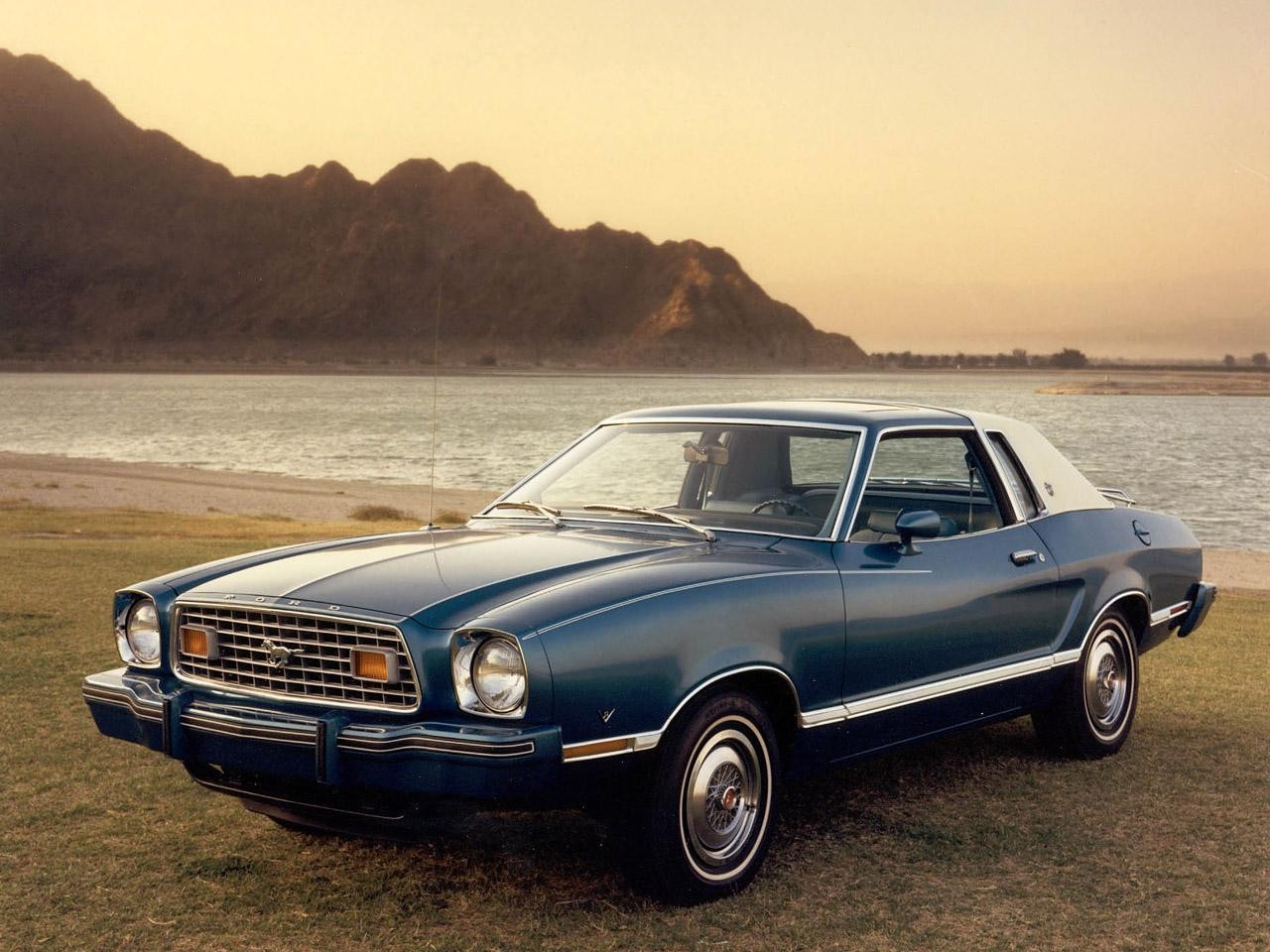
Ghia
The 1974 Mustang Ghia was a special sport luxury package for the 2-door coupe body style. The Ghia options package included spoke-style wheel covers, a vinyl roof, deluxe color-keyed seat belts, remote-controlled door mirrors, a Super Sound package, shag carpeting, wood-tone door panel accents, a digital clock, and a super-soft vinyl or Westminster cloth seats. Ford used the 1970 acquired Ghia Italian design firm for these design choices.
Learn more about the 1974 Ford Mustang Ghia
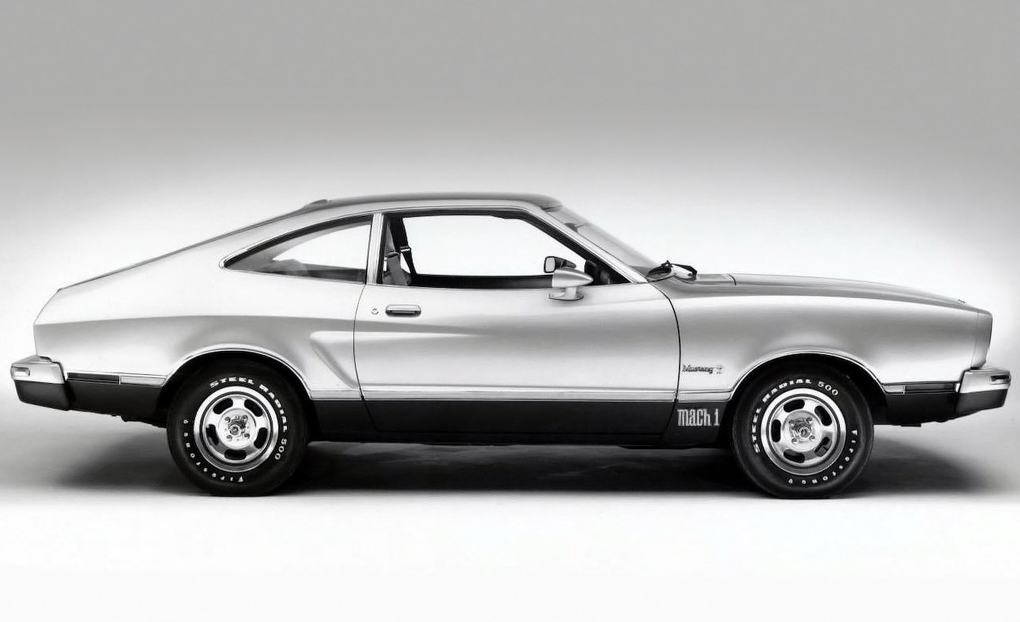
Mach 1
The 1974 Mustang Mach 1 offered styled steel wheels with chrome trim rings, remote control racing mirrors, and unique paint tape treatment on the newly designed hatchback body style. The Mach 1 received a 2.8L V6, lower body tape kit that of all things read MACH 1. V8 engines were not available in 1974 in the Mustang II.
Learn more about the 1974 Ford Mustang Mach 1
Specifications, Options & Detailed Stats
Production Numbers
A total of 385,993 Mustangs were sold in 1974, a massive jump in total sales (up 186% from the previous year). To dive into the model and body splits as well as see charts and percentages, check out our 1974 Ford Mustang Production & Sales Numbers deep dive.
Options and Pricing
This was the beginning of the second generation Mustangs. The hardtop was offered as a Ghia or luxury style and the hatchback was offered as a Mach 1 or sporty looking (but not performing) option. The default engine was the “LIMA” engine a 140 cubic inch 4 cylinder overhead cam slug with 88 horsepower. Popular options for 1974 included air-conditioning, various radios and tape players, sunroof, bodyside moldings, styled steel wheels, forged aluminum wheels, and bumper guards. For more detailed options and pricing, please check out our 1974 pricing and options research.
Exterior & Interior Colors
A total of 14 exterior colors were offered for the 1974 Mustang model year. There weren’t many special colors this year so total exterior color options came in at a total of 16 colors. For detailed colors, color palettes, codes and interior colors please check out our in depth 1974 colors information post.
Dimensions & Weight
Engine Specs
For more information on engines for 1974, you can find the information here.
Performance
Below is the performance data for the 1974 Mustangs that we could find. As you can see, Mustang performance took a big step backwards. We have included 0-60 mph times, 0-100 mph times as well as quarter mile times and top speed.
VIN Information
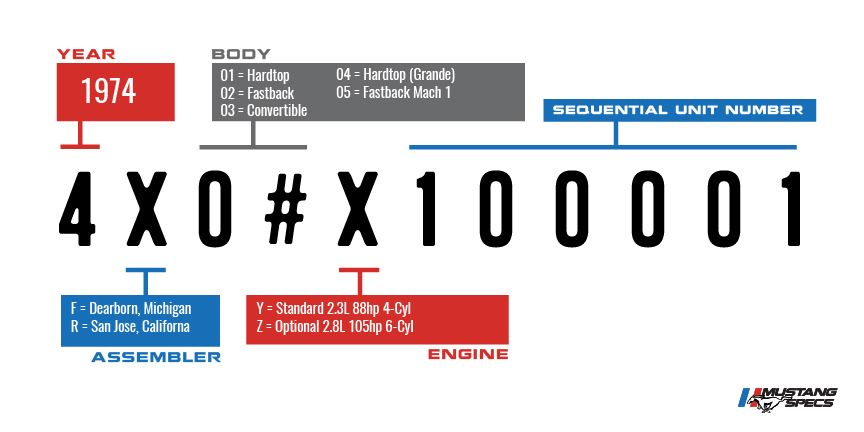
This link will take you to a page which contains the VIN tag information for all years of Mustangs. Previously this information appeared on each Mustang’s year page, but consolidating it has significantly reduced page loading times. To decode the build sheet, check out our 1974 VIN & Data Plate Decoder sheet.
Videos & Picture Galleries
We managed to find some great video reviews of the 1974 Mustang so definitely check those out. We also have a picture 1974 Ford Mustang Picture Gallery and photos of real Mustangs in each color that was available.

The Blue Mustang Ghia pictured on this page is not a 1974. It is a 1976 -1978. The V-8 engine wasn’t available on the 1974. Also the gas cap was lower on the 1974s. It was below the belt line. Also on the 1974 the grille was recessed into the housing. The grill had to be pulled forward to make room for the V-8 engine. I owned a 1975 Mustang II Mach I, and sold Fords from 1975 to 1979.
Wow, nice catch! You know your Mustangs. I always liked these cars, even given the lack of performance. These were very nice looking, comfortable and for the day, luxurious cars. Performance is important but it’s not everything.
I want too put a 2.3- Cylinder Engine and Tranny (AC) from a 2011 Ford Ranger
Into a 1977 Ford MustangII; where there is a 2.3 4cyl with far less horsepower and torque (without changing out the rear-end) for a Daily Driver.